Course


Virology – Biology W3310

Spring 2013

Click here for material from the 2012 virology course

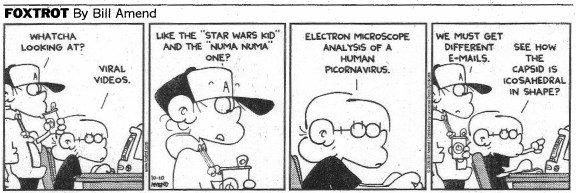
viral video

This Columbia University virology course is offered each year in the spring semester.

Prerequisite: Two semesters of a rigorous, molecularly-oriented Introductory Biology course (such as C2005), or the Instructor’s permission (vrr1@columbia.edu).

Course Name: Virology
Sessions: M, W 4:10 – 5:25 PM
Start date: Wednesday, January 23, 2013
Points: 3
Location: Northwest Corner 501
Course #: Biology W3310.001 or W4310.001
Instructors: Prof. V. Racaniello, Prof. S. Silverstein

Description

The basic thesis of the course is that all viruses adopt a common strategy. The strategy is simple:

1. Viral genomes are contained in metastable particles.

2. Genomes encode gene products that promote an infectious cycle (mechanisms for genomes to enter cells, replicate, and exit in particles).

3. Infection patterns range from benign to lethal; infections can overcome or co-exist with host defenses.

Despite the apparent simplicity, the tactics evolved by particular virus families to survive and prosper are remarkable. This rich set of solutions to common problems in host/parasite interactions provides significant insight and powerful research tools. Virology has enabled a more detailed understanding of the structure and function of molecules, cells and organisms and has provided fundamental understanding of disease and virus evolution.

The course will emphasize the common reactions that must be completed by all viruses for successful reproduction within a host cell and survival and spread within a host population. The molecular basis of alternative reproductive cycles, the interactions of viruses with host organisms, and how these lead to disease are presented with examples drawn from a set of representative animal and human viruses, although selected bacterial viruses will be discussed.

Textbook

The recommended textbook is Principles of Virology. Vol I: Molecular Biology, Vol. II: Pathogenesis and Control (S.J. Flint et al., Third Edition, ASM Press 2009).

Other course resources

1. Students are expected to read Prof. Racaniello’s virology blog which will contain information relevant to the course.

2. Students are expected to listen to the weekly podcast “This Week in Virology”, produced by Prof. Racaniello, for additional material about viruses relevant to the course. You can subscribe to TWiV at iTunes or at the Zune Marketplace.

3. Lecture slides (pdf) will be posted at Courseworks and at this website before each class.

4. Videocasts of all lectures (slides plus audio) will be posted at Courseworks, at this website, and at iTunes University.

Click here for material from the 2012 virology course

Lecture Schedule, Spring 2013
Note: Several videocast file types are available – right-click and save as to download. Videos are also available at YouTube.

Date Topic Reading Lecturer Slides Videocast (right click, save as)
1/23 Lecture 1
What is a virus?
Flint vol 1 chapter 1

Are viruses living?

What is a virus?

Are viruses alive? (take the poll)

VRR pdf iPod
iPhone
iPad/mac
pc
1/28 Lecture 2
The infectious cycle
Flint vol 1 chapter 2

Influenza virus growth in eggs

Influenza hemagglutination inhibition assay

The amazing HeLa cells of Henrietta Lacks

VRR pdf iPod
iPhone
iPad/mac
pc
1/30 Lecture 3
Genomes and genetics
Flint vol 1 chapter 3

Simplifying virus classification: The Baltimore system

Clinical benefit of lentiviral gene therapy in two patients with a rare neurological disease

VRR pdf iPod
iPhone
iPad/mac
pc
2/04 Lecture 4
Structure of viruses
Flint vol 1 chapter 4

Structure of influenza virus

Virus images at ViperDB

VRR pdf mac
iPod
iPhone
iPad
pc
2/06 Lecture 5
Attachment & entry
Flint vol 1 chapter 5

Influenza virus attachment to cells

Influenza virus attachment to cells – Role of different sialic acids

VRR pdf mac
iPod
iPhone
iPad
pc
2/11 Lecture 6
RNA-directed RNA synthesis
Flint vol 1 chapter 6

Influenza viral RNA synthesis

The error prone ways of RNA synthesis

VRR pdf mac
iPod
iPhone
iPad
pc
2/13 Lecture 7
Replication of DNA virus genomes
Flint vol 1 chapter 9
Making viral DNA I (TWiV)
Making viral DNA II (TWiV)
SJS pdf mac
iPod
iPhone
iPad
pc
2/18 Exam I Lectures 1-7   Study questions (pdf)  
2/20 Lecture 8
Transcription and RNA processing
Flint vol 1 chapters 8, 10
Processing VIRALGUUAACACCAGRNA(TWiV)
Study questions (pdf)
SJS pdf mac
iPod
iPhone
iPad
pc
2/25 Lecture 9
Reverse transcription and integration
Flint vol 1 chapter 7

Museum pelts help date the koala retrovirus

Unexpected endogenous viruses
Study questions (pdf)

VRR pdf mac
iPod
iPhone
iPad
pc
2/27 Lecture 10
Translation
Flint vol 1 chapter 11
Study questions (pdf)
VRR pdf mac
iPod
iPhone
iPad
pc
3/04 Lecture 11
Assembly
Flint vol 1 chapters 12, 13

Packaging of the segmented influenza RNA genome
Study questions (pdf)

VRR pdf mac
iPod
iPhone
iPad
pc
3/06 Lecture 12
Infection basics
Flint vol 2 chapters 1,2

Transmission of influenza
Slow motion sneezing
Chikungunya, an exotic virus on the move
Do the tropics have a flu season?
Study questions (pdf)

VRR pdf mac
iPod
iPhone
iPad
pc
3/11 Lecture 13
Host defense
Flint vol 2 chapter 4

The inflammatory response

Natural antibody protects against viral infection
Study questions (pdf)

VRR pdf mac
iPod
iPhone
iPad
pc
3/13 Lecture 14
Virus-host interactions
Flint vol 2 chapters 3, 4
Immunopathology – Too much of a good thing
Severe cases of pandemic influenza
Antimicrobial peptides induced by herpesvirus enhance HIV-1 infection
Study questions (pdf)
VRR pdf mac
iPod
iPhone
iPad
pc
3/18 – 3/22 Spring Recess
3/25 Lecture 15
Viral evasion strategies
Flint vol 2 chapters 3, 4
Study questions (pdf)
SJS pdf mac
iPod
iPhone
iPad
pc
3/27 Lecture 16
Persistent infections
Flint vol 2 chapter 5

Persistent viral infections
Study questions (pdf)

SJS pdf mac
iPod
iPhone
iPad
pc
4/01 Exam II Lectures 8-16  
4/03 Lecture 17
Acute infections
Flint vol 2 chapter 5

Acute viral infections

Chronology of an acute infection
Study questions (pdf)

VRR pdf mac
iPod
iPhone
iPad
pc
4/08 Lecture 18
HIV pathogenesis
Flint vol 2 chapter 6

TWiV 133: The HIV hideout
A tale of two viruses
Study questions (pdf)

VRR pdf mac
iPod
iPhone
iPad
pc
4/10 Lecture 19
Transformation and oncogenesis
Flint vol 2 chapter 7
TWiV 163: What Rous wrought
Study questions (pdf)
VRR pdf mac
iPod
iPhone
iPad
pc
4/15 Lecture 20
Vaccines
Flint vol 2 chapter 8

Influenza virus-like particle vaccine

Poliovirus vaccine safety
Study questions (pdf)

VRR pdf mac
iPod
iPhone
iPad
pc
4/17 Lecture 21
Antivirals
Flint vol 2 chapter 9

New hepatitis C virus antiviral drugs

An antiviral for enveloped viruses

TWiV 146: Draco’s potion
Study questions (pdf)

VRR pdf mac
iPod
iPhone
iPad
pc
4/22 Lecture 22
Evolution
Flint vol 2 chapter 10 pp 311-333

Virulence: A positive or negative trait for evolution?

Increased fidelity reduces viral fitness
Study questions (pdf)

VRR pdf mac
iPod
iPhone
iPad
pc
4/24 Lecture 23
Emerging viruses
Flint vol 2 chapter 10

Lujo virus, a new hemorrhagic fever virus from Southern Africa

The zoonotic pool
Study questions (pdf)

VRR pdf mac
iPod
iPhone
iPad
pc
4/29 Lecture 24
Unusual infectious agents
Flint vol 2 Appendix A

Virophages engineer the ecosystem
Study questions (pdf)

VRR pdf mac
iPod
iPhone
iPad
pc
5/01 Lecture 25
XMRV
Flint vol 1 chapter 7

Why John Coffin doesn’t sleep well

HIV in XMRV out

XMRV is a recombinant virus from mice
Study questions (pdf)

VRR pdf mac
iPod
iPhone
iPad
pc
5/06 Lecture 26
H5N1
TWiV 177: Live in Dublin

A bad day for science
Study questions (pdf)

VRR pdf mac
iPod
iPhone
iPad
pc
5/13 Exam III Lectures 17-26  


  • Pingback: My virology course at Columbia University

  • Pingback: This year in virology

  • Pingback: TWiV 153: Rabid reindeer and protective prions

  • Pingback: David and Goliath: How one cytokine may take down influenza

  • Pingback: Women AND men beware: HPV, the culprit behind more than just cervical cancers?

  • Pingback: Happy as a clam? Maybe not.

  • Pingback: Viruses go green – making solar cells using a bacteriophage

  • Pingback: Not-so-similar fate of identical twins infected with HIV-1

  • Pingback: A virology course at Columbia University

  • Pingback: Virology course at halfway point

  • Svitka

    Thank you ever so much for making these materials available to the interested public.  It is a terrific service.

  • Aake Bjoerk

    Thanks for putting this up !
    Great to be at home and take this in at your own pace.
    I am a little disabled so all Internet services are a tremendous benefit !

    Downloading slides 1-14 worked ok.

    Downloading videocasts worked ok, except for lecture 9 and 13.

    Would be great if  I could get hold of these as well.

    Best regards Aake from Sweden

  • http://www.virology.ws profvrr

    I believe I have fixed the errant files, please try again. If not let me know.

  • Aake Bjoerk

     Lecture 9 and 13 are now fixed !

  • Saintson

    Dear Prof. V. Racaniello

    Thank you very much for providing so many materials. But I can not download the pdf  for Exam I.

    Best wishes

  • http://www.virology.ws profvrr

    Sorry, that file is fixed and should now be available.

  • smsavage

    I was wondering if there was anyway that the answer sheet may be posted for the two sets of review questions? I have done them, I am just wanting to check my answers to see if I am correct. Thanks

  • http://www.virology.ws profvrr

    I can do that, but it will take a bit more time, perhaps a week or two.

  • Pingback: A mad cow in America

  • Pingback: Earth’s virology professor

  • Guest

    Dr. Racaniello,My boxing instructor was quizzing me on the questions in the study guide for the final exam today, and if I hadn’t before, I had really come to appreciate everything that I’ve learned in your course then. Most notably, I was so surprised to hear him say that he and his friends thought that HIV arose from humans having sex with monkeys, and that homeopathic medicine could cure HIV.  In discussing and explaining the different topics to him, I really think that you are fulfilling a great need by educating the public about viruses.  I am so thankful for everything that I’ve learned, and I appreciate the opportunity that your course has given me to bring the science and reality of viruses to others.  Thanks!

  • Manuel

    Hello Proffesor
    Is it possible to have the student questions on subtitles or something? i learn also from questios of the other students and if i dont have them i can get lost in the middle of the clas.

  • Adrian Tween

    I am a biology student. I finished my undergraduate studies and I thank you for giving me something to do while I figure out where to study next as I can’t apply for anything sooner than Spring 2013 this year. Thanks a lot.

  • Andy A.

    Hello professor,

    Thank you for these lectures! These are great video lectures that really captivate me and help supplement my learning at UTSA. I was wondering if you had answer sheets you could post up for the review questions you have on here? That would be fantastic.

    Thanks again!

  • P Yk Chong

    Dr. Racaniello, I have a little suggestion, maybe you can keep us update with some of the good journal papers time by time? It will be a good kickstart for those who love to immerse themselve in fascinating virology. =)

  • Pingback: A virology course for all

  • Farheen

    Hi, I’m new to this and absolutely thrilled to have found this course! Wondering if I’m too late to start or is this self-paced? Do we get a certificate at the end, like the Coursera or Udacity courses? Thank you.

  • Phil

    Hi Prof Racaniello,

    Would it be possible to upload the videocasts for the second half of the course again please? I’m studying Virology MSc in London, UK and find the videocasts extremely helpful learning material.

    Many Thanks,

    Phil

  • http://www.virology.ws profvrr

    Phil, all the lectures from 2012 are still online – there is a link at the very top of this page. The lectures on the current page are from this year’s course which is still in progress.

  • Phil

    Found it! Thank you.

  • Pingback: How I record my lectures

  • Linsey Marr

    Thank you very much for making your lectures available to all. It’s a fantastic resource for my research group that is studying aerosol transmission and as an example as I think about moving my own courses at least partially online.