
 The purpose of this blog is to teach you about viruses and viral disease. This topic is not one that everyone understands, yet nearly everyone would like to. I was most disturbed when the Secretary of Health and Human Services, Tommy G. Thompson, referred to the anthrax bacillus as a virus. That incident crystallized in my mind the need to better educate the public about viruses.
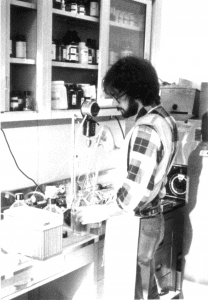
I am your host at virology blog – Vincent Racaniello Ph.D., Professor of Microbiology & Immunology in the College of Physicians and Surgeons of Columbia University. Why am I qualified to teach you virology? I have done laboratory research on viruses since 1975, when I entered the Ph.D. program in Biomedical Sciences at Mt. Sinai School of Medicine of the City University of New York. My thesis research, in the laboratory of Dr. Peter Palese, was focussed on influenza viruses. That’s me in the black and white photo below, taken in 1977. Yes, I’ve changed.
In 1979 I joined the laboratory of Dr. David Baltimore at Massachusetts Institute of Technology, where I did postdoctoral work on poliovirus. The moratorium on cloning full-length viral genomes had just been lifted, so I proceeded to make a DNA copy of poliovirus RNA, using the enzyme reverse transcriptase. I cloned this DNA into a bacterial plasmid and determined the nucleotide sequence of the poliovirus genome. In an exciting advance, I found that a DNA copy of poliovirus RNA is infectious when introduced into cells. This was the first demonstration of infectivity of a DNA copy of an animal RNA virus, and it permitted previously unthought of genetic manipulations of the viral genome. Today infectious DNA clones are used to study most viruses.
In 1982 I joined the faculty in the Department of Microbiology at Columbia University College of Physicians & Surgeons in New York City. There I established a laboratory to study viruses, and to train other scientists to become virologists. Over the years we have studied a variety of viruses including poliovirus, echovirus, enterovirus 70, rhinovirus, and hepatitis C virus. As principal investigator of my laboratory, I oversee the research that is carried out by Ph.D. students and postdoctoral fellows. I also teach virology to undergraduate students, as well as graduate, medical, dental, and nursing students.
Since I think about viruses every day, and I have always been interested in teaching others about viruses, this blog seemed to be an ideal forum to convey some of my knowledge on this topic.
After starting this blog, I became interested in using ‘new media’ (internet-based media) to disseminate information about viruses. I’ve summarized my use of this format in an article entitled “Social media and microbiology education“, which you can find at the open-access journal PLoS Pathogens. In addition to writing about viruses on virology blog, I also host and produce five podcasts: This Week in Virology, This Week in Parasitism, This Week in Microbiology, This Week in Evolution, and Urban Agriculture. You can find them all on iTunes or at MicrobeTV. I teach a virology course each spring at Columbia University, and I post videocasts of each lecture at the course website, at YouTube, at iTunes University, and at Coursera.
If you would like to learn about our work on viruses in more detail, please visit my website at Columbia University, or my Wikipedia page. You might also like to follow me on Twitter or Google+, where I often provide links to interesting stories about viruses; on YouTube, where I posts videos about viruses; or on Instagram, or the This Week in Virology page on Facebook. I have also written about my work on this site; links to some of these articles are provided below.
Thirty years in my laboratory at Columbia University
Edwin D. Kilbourne, MD, 1920-2011 (his influence on my career)
Thirty years of infectious enthusiasm
Transgenic mice susceptible to poliovirus
Viruses and journalism: Poliovirus, HIV, and sperm
Viruses and journalism: Off-the-shelf chemicals
Disclaimers
All of the opinions that I write on this blog are mine, and in no way represent the views of my employer, Columbia University. This information is provided for educational purposes only, and should not be considered medical advice. If you think you are sick, see your doctor. Links to other sites do not constitute endorsements of those sites.
Vincent Racaniello
I am not a medical professional, this isn’t a medical advice, as that’s against the rules and conduct of this group. This is merely is suggestion, because I’ve had good success with
alternative approach. Dr Anetor an empathic, and attentive Naturopath, with his innovative approach combining natural herbs helped addressed and healed me of herpes 1&2, gallstones and thyroid disease, I’m fully recovered, living completely symptoms and flare free. Contact him via email: Anetorherbs@gmail.com
Phone no: +234 7051520463
I started my herpes herbal treatment last month from Doctor Excel a herbalist and immediately after I finish drinking the herbal medicine which he sent to me through DHL then I went to the lab for several test and so amazingly my results came out negative in all the test that I did. Doctor Excel herbal medicine cured me of my herpes virus after all the symptoms disappear the moment I started drinking the meds. Get to know about this herbal doctor and his herbal medicine for herpes on his website: https://excelherbalcure.com
I found your podcast under the You Might Also Like section in Apple Podcasts for a podcast we have a campaign for. PodRoll campaigns are a way for you to earn more revenue from your podcast without extra work. It is a marketplace for episode recommendations, like a banner ad, but in your feed. You get paid for every download, with full control over what’s promoted. It runs automatically, like a sponsorship, without manual ad sales or edits. Podcasters with 100K downloads/month are earning $4K–$6K/month. Let me know if you’re interested in checking out the campaign or any others we have available!
My apologies to everyone, but i have to share this to help one or two people out there. What else can I say about him, today am equally very grateful to Dr.Water as I am finally cured of HIV disease that have been eating me up for over a year and 6 months. After searching for different means to get my self cured but nothing seems to work out, behold today i can boldly stand and testify to the world at large that with the help of herbal medicine, I have found myself back to my feet and healthy again in just after few weeks after i got in contact with a great herbalist, through help on a blog which talk about HIV cure. Few weeks ago, i saw an article of a lady explaining how she was cured after using some herbal medicines which was sent to her by Dr.Water. So i decided to give this great man a try by contacting him via his email and mobile number. I explained to him what my problem was, and he promised me that all would be fine and well by the time i finish using his remedy. I just had to believe in him, which i did. Low and behold, today i am very happy. It was just all like a magic when my blood sample tested negative. That is why i have come here to testify to the world at large and also to share my experience because I know there are many people out there who are also searching for a cure to one disease or the other. You can as well get in contact with DR.WATER now for his herbal medicines, through his Facebook https://www.facebook.com/share/1BNosvY4pc/. Write him today, I fully believe he will be able and capable to cure your own HIV/AIDS and can also cure all of these diseases as well: HEPATITIS B, HPV WARTS, CANCER, HERPES SIMPLEX VIRUS, ALS, DIABETES TYPE1&2, INFERTILITY IN BOTH MALE AND FEMALE
Hi virology.ws
Looking for an AI content tool that doesn’t tie your hands?
We built one — and now it’s going global.
https://tinyurl.com/ai-mega-tool
XGPTWriter 4 Global is a desktop AI writing app built for scale, speed, and full control.
You install it once — and you’re off. No logins, no browser juggling, no hidden limits.
Inside:
• Instant demo — no registration needed
• Works with ChatGPT’s web version (even free accounts)
• Or plug in your own API keys — your call
• 50+ languages, brand voice control, SEO-ready output
• Long-form content, landing pages, social posts, emails, even image generation
• Built-in prompt system, full tone control, CMS integration
This is our 4th version, after 3 years of real-world use in Eastern Europe.
Now — it’s ready for global teams and solo creators alike.
Try the Demo — No Sign-up:
https://tinyurl.com/ai-mega-tool
Let me know if you want a quick video walk-through or setup tips.
What Happened to Chargaff’s Rules?
Your hardest journeys often lead you to the most beautiful places. Trust the winding road. It’s shaping you into your strongest version.
Your words carry a warmth that’s hard to describe.
You don’t have to earn your right to peaceIt is yours.
I am genuinely excited with Meduza as his spell has provided me with financial stability after winning $273 MILLION from the New Jersey lottery with his accurate numbers. Email him for help via: lordmeduzatemple @ hotmail . com