
 Before the development of cell culture, many viruses were propagated in embryonated chicken eggs. Today this method is most commonly used for growth of influenza virus. The excellent yield of virus from chicken eggs has led to their widespread use in research laboratories and for vaccine production. In fact the vast majority of influenza vaccines – both inactivated and infectious – are produced in chicken eggs. How is influenza virus propagated in eggs?
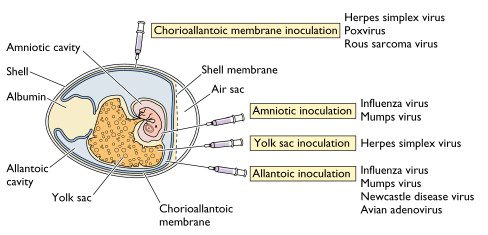
The illustration below shows a cutaway view of an embryonated chicken egg. The different routes of inoculation into the egg are shown, as well as the different compartments in which viruses replicate.
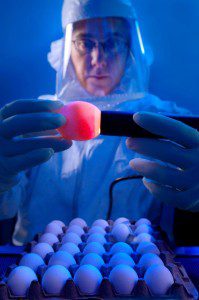
For propagation of influenza virus, pathogen-free eggs are used 11-12 days after fertilization. The egg is placed in front of a light source to locate a non-veined area of the allantoic cavity just below the air sac. This is marked with a pencil. After all the eggs have been ‘candled’ in this way, a small nick is made in the shell at this position using a jeweler’s scribe. Next, a hole is drilled at the top of the egg with a Dremel motorized tool. If this is not done, when virus is injected, the pressure in the air sac will simply force out the inoculum.
After all the eggs have been nicked and drilled, they are inoculated with virus using a tuberculin syringe – a 1 ml syringe fitted with a 1/2 inch, 27 gauge needle. The needle passes through the hole in the shell, through the chorioallantoic membrane, and the virus is placed in the allantoic cavity, which is filled with allantoic fluid. The two holes in the shell are sealed with melted paraffin, and the eggs are placed at 37 degrees C for 48 hours.
During the incubation period, the virus replicates in the cells that make up the chorioallantoic membrane. As new virus particles are produced by budding, they are released into the allantoic fluid. To harvest the virus, the top of the egg shell – the part covering the air sac – is removed. We used to have a special tool to do this, which was placed over the egg. When the handle of this tool is squeezed, it makes a neat crack around the top of the egg. It was then easy to remove the flap of shell with tweezers. The shell membrane and chorioallantoic membrane are pierced with a pipette which is then used to remove the allantoic fluid – about 10 ml per egg. Sufficient virus may be produced in one or two eggs (depending on the viral strain) to produce one 15 microgram dose of vaccine.
We used to grow so much influenza virus that a large walk-in warm room was used as an egg incubator. When you opened the door of the incubator and heard peeping, it meant that someone had left unused eggs too long and they had hatched. Then you were left with the task of catching the evasive chicks.
 I find it AMAZING that no one on this board (that I’ve read thus far) is questioning the method much less the practice of manufactured vaccines. Non vaccinated people I know are FAR healthier than the vaccinated I know. Yes, this is not necessarily scientific evidence created in a lab but does it make the fact any less true? NO. I refuse to vaccinate my children and it has turned out to be the BEST decision I have ever made. Why don’t you people educate yourselves intsead of allowing multi billion dollar companies and their cronies do it for you?
 Bill Gates has said that vaccines are great for CONTROLLING the population. Veterinarians ADMIT OPENLY that some of their vaccines (i.e.rabies) can cause cancer (fibrosarcoma) in animals and look at all the autoimmune disorders in animals and humans (even children). Say it as much as you want but these diseases and chronic illnesses were NOT common in the past and are on the rise for us in the future because you can’t fight fire with fire or should I say you can’t fight disease with disease (unless it is acquired naturally which is the ONLY way to acquire LIFELONG immunity). For an even more obvious example, take a look at indigenous people around the world who are never afflicted with the diseases “civilized” cultures are. Case in point: “Nutrition and physical degeneration” by Weston Price. While this book focuses mainly on diet as a natural immunity to what is now considered common diseases, consider that vaccines were also used at this time and that furthermore, the indigenous did not use these “life saving” vaccines. As Dr. Tenpenny says: “Health does not come through a needle.” I could go on and on but do your own research. This country is a poor example for health to say the least. We come in 49 on infant mortality rate among nations. This is up from years past…so we are actually getting worse…please use your heads. I’m only saying this because I care about the children, the innocent children being posioned by their brainwashed parents.Â
Profvrr , nice look at the procedure. We enjoyed the more practical questions and comments. statistics are useful, whether used by the tobacco industry, or those who skew them for other reasons. Weaponized biologicals do not respond well to “pop” scare publications. We as a species are doing some quite foolish things contrary to our survival as a species. How do viruses compare? It is surprising that over a 2 year period no one asked about why the points of injection and placement of viruses were chosen to be different for different viruses. Is there a pattern among groups of viruses or other reasons?
Noooooooooooooooooooooooooooooooooooooooooooooooooooooooooooooooooooooooooo! dON’T CHICKENS ARE CUTE!
The irony of an anti vaccine psychopath talking about brainwashed parents harming their children made me laugh, hard. The statistics clearly show that non vaccinated children who don’t die horrible deaths are lucky there is here immunity from responsible mature educated parents loving their children enough to vaccinate.
Go back to the dark ages you hippie twat, and take your pseudoscientific woo peddling with you. Your kind has been proven wrong time and time again by facts and science, your arguments are anecdotal and illustrate logical fallacy, and you all tend to believe in grandiose big pharma conspiracy theories and show severe signs of mental illness. You’re not worthy to have children. Now sit the fuck back down and go die of chicken pox you mole.
You left out the most important part of the magic; what is done with the grown virus to turn it into a vaccine? How is the dosage of the grown virus determined for the inoculation itself?
Ha hah ha…B-)
B, I hope you line up every single fucking yr. for your flu vaccine. Yes, there are a growing population of “hippies” because more & more people can’t help but WAKE UP to the toxicity of vaccines..just keep lining up for your flu shot, B…like a good little sheepie. You’ll wake up too after you get sick from being poisoned or your kids get sick. The question is will you be smart enough to put two & two together when that vaccine makes you or your kid sick? Or will you be a sheepie in denial?
Pingback: A Home For The Common Cold | That's Basic Science
Guess the chicks will be infected?
Check this out. They do exactly this in cell culture method:
Hamamoto
I, Takaku H, Tashiro M, Yamamoto N (2013) High Yield Production of
Influenza Virus in Madin Darby Canine Kidney (MDCK) Cells with Stable
Knockdown of IRF7. PLoS ONE 8(3): e59892. doi:10.1371/journal.pone.0059892
Smallpox, polio,
tetanus, measles, mumps, rubella, influenza, diphtheria and the list goes on.
All of these diseases in past causes thousands and even millions a horrific
deaths and for you to just ignore that part of history as false is truly insulting
to your own intellect. There was a time when 50 million people died from the
flu, smallpox destroyed civilisations and stepping on a rusty piece of metal
often resulted in death, this was not that long ago either. You clearly do not
understand biology or the immune system, vaccines are not the disease, they are
disease substitutes to allow your own immune system to develop a natural and
lifelong immunity “your own words here†towards the disease. There is no
conspiracy, there is just scientists trying to save lives. Remember when South
Africa rejected the polio vaccine? Now have a look at them and the poor surrounding
countries. This should not care about you and what you do with your life, but
this attitude towards vaccines really grinds my gears, if anything you should
be against antibiotics because they do not confer natural immunity. I sure hope
reality bites you in the ass when your kids contract a crippling disease that
could have been prevented, let’s see your healthy diet save your kids from death
then.
Pingback: A Natural Alternative to the Flu Shot Vaccination
O my, what an idiot!
Dear, Sir
I have a question, We Harvesting Strain B in egg, this fluid color is dark brown(We does UltraFiltrationed).
but Strain A(H1N1, H3N1) color is Dark Yellow. Is it right? If that is right, why so diffrent color? Please give me a answer.
I’m mostly a sheep
farmer, but I have chickens and ducks for personal use. I’m wondering
how to grow up the eggs faster? I heard that it’s really easy if
I’m using incubator like this one here
http://incubatorsatilir.meximas.com/index.htm . Is there any other
ways?
Cyanpku, here you can see what happen after they being caught https://www.youtube.com/watch?v=-o2JqjkB3pg
I’m working with NDV Lasotta to check the mechanism of its oncolysis in human tumor cell lines. Is there any effect of chicken allantoic fluid to human cell?
Pingback: Explanatory Story: Picking the Annual Flu Vaccine | Integrated Biology
So many rude comments here. I hope people can evolve past rudeness and name calling. No one in my family gets the flu shot. The flu shot is not necessary. I am around thousands of people every day who also do not receive the flu shot – I work at a huge university. At the same time I would not take any advice from Weston Price. I do agree – Americans like to equate health with shots, medicines, and supplements. I never take any of these. 47 years old, female, 100% healthy, vegan. Peace.
I love how full of anger you are. I wish there was a vaccine for hateful bastards. Lol.
My kids are not vaccinated and have never needed antibiotics, my oldest is 5 y/o and is healhier than me. I had chicken pox, measles and mumps, I breastfeed them and I still have the antibodies. Nutrients and vitamins are the best defense against any disease, since Istarted taking them,none of us have needed to go to the doctor’s office, my fiance only has two colds in 7 years we have lived together. He is the one that educated me about vaccines and I listened. I am so glad I did.
Hello,
I know this is an old post, but do you know precisely what chemicals are used to make the virus inactive so that it can safely be used for vaccination?
Thank you!
The history line is a commonly used argument, however, the actual data shows that incidence and death rates of ALL those diseases had declined substantially and had virtually bottomed out prior to the introduction of vaccines, as a result of sanitation, healthier diets, and better medical care. With smallpox, however, rates of infection and deaths actually went up with vaccination, amongst the vaccinated population. It took appropriate medical care, quarantine, and sterile medical practices to bring the problem under control. The health of the host makes more difference in rates of infection and mortality than the presence of the microbe.
I have only had the flu shot once, when it first came out and got very sick shortly thereafter, as the vaccine actually depresses the immune system initially. Because of how sick I got, I have never been willing to have it since. And after converting to natural medicine 13 years ago, I have only been sick a few times and then only very mildly.