
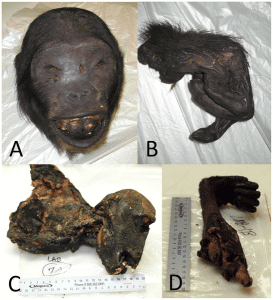
 The finding of viral nucleic acid sequences in illegally imported wildlife products has attracted the attention of the New York Times, which published an article entitled From the jungle to J.F.K., viruses cross borders in monkey meat. It begins with a scary scenario:
This may read like a passage from a Richard Preston novel, but all an enterprising virus needs to do is jump aboard a traveling human or animal, and bam,the potential for a catastrophe akin to the 1918 Spanish influenza pandemic could emerge. That’s why the Centers for Disease Control and the Wildlife Conservation Society decided to undertake their first surveillance efforts for diseases of animal origins crossing in the United States.
However, the PLoS One paper that is cited in support of this story found short viral sequences, not viruses, in material confiscated at several airports. The authors of this report extracted nucleic acids from confiscated specimens (which included fresh, raw, lightly smoked or dried samples from chimpanzees, mangabeys, guenons, and rats) and screened them for pathogen nucleic acids by polymerase chain reaction (PCR). The authors note that “RNA quality was low with a predominance of degraded, low molecular weight fragments in the samples”. They identified small PCR DNA products from the genomes of simian foamy virus (a retrovirus) and herpesviruses in 15 out of 48 specimens. No complete viral genomes or infectious viruses are reported in the paper.
Perhaps the Times was mislead by the title of the PLoS One paper: Zoonotic Viruses Associated with Illegally Imported Wildlife Products. The abstract is similarly misleading:
Pathogen screening identified retroviruses (simian foamy virus) and/or herpesviruses (cytomegalovirus and lymphocryptovirus) in the NHP samples.
The authors correctly report their results at the end of the introduction:
Here we report finding sequences of simian retroviruses and herpesviruses in bushmeat confiscated at five US airports
Infectious viruses might accompany imported smoked monkey heads, dried bats and rat parts. The presence of small fragments of viral nucleic acids suggests that these materials were indeed once infected. But it is a large leap of faith to suggest that infectious agents are still present. It’s a good idea to use PCR to screen such material, but it is important to be specific when reporting the results. My suggestions for revised titles: Zoonotic viral sequences associated with illegally imported wildlife products (PLoS One) and From the jungle to J.F.K., small fragments of viral nucleic acids cross borders in monkey meat (NY Times). Far less interesting, but factually correct.
Would any deceased body that had an active viral infection at the time of death have similar “leftover” viral sequences found in its tissues? It’s my understanding that after the host dies, most pathogenic microbes in the host die almost immediately – true?
Mmm, smoked monkey head.
The Times article is indeed overstating the findings, but we should also assign at least some blame to the American Museum of Natural History, which sent out this press release to accompany the paper. If you read the release, you’ll see the seeds for exactly the type of sensationalism Rachel Nuwer produced. The PLoS authors themselves may have fanned the flames a bit as well, judging from the quotes.
I do think that science journalists should be more careful about over-hyping the data, but the scientists and their sponsors are often part of the problem as well.
Did they actually find virus particles in the rodent (cane rat and rat) meat? The article specifies which virus particles they found in non-human primates, but I didn’t see any listed for the rodents.
Looking over this article they just did PCR verification of DNA-based virus transcripts? With RNA not long-lived it would seem unlikely none of these are RNA-based virus transcripts (RT-PCR). While it seems many journals do this PCR inferences I sometimes cringe at these PLOS-based publications especially when the authors say in the abstract this could be a “conduit” for virus spread. Maybe I should do viral PCR analysis on Monsanto crops, Exxon oil fields and McDonalds-grown beef.
Good point. PCR- detection assay not a functional assay. The reporters don’ t understand
I use to love eating this meat when I was living in Africa. I’ll eat it again someday when I go back, because I really miss this good stuff.
Pingback: Part of MERS-CoV nucleotide sequence found in a bat
unatoka wapi?
Pingback: +Ken Foreman This is similar to what we’re talking about re:@herpderpedia, lack of reading, willful … | Sapient Sapiens