
 What would you conclude if you read the following headlines: Man sexually transmits insect-borne disease to wife (Fox News); Zika virus: First insect borne STD? (HuffPo); Scientist gives insect-borne disease to wife during sex (New York Magazine), and A scientist contracts a mosquito-borne virus and gives it to his wife as std (Time). What would be your impression if you read the journal article on which these headlines are based, which does not conclude that the infection was transmitted sexually?
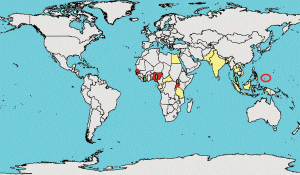
Zika virus was isolated in 1947 from a monkey in Uganda, and subsequently shown to be transmitted by mosquitoes. Zika is classified as a flavivirus, along with well-known human pathogens such as yellow fever virus, dengue virus, and West Nile virus. Infection of humans with Zika virus leads to headache, fever, malaise, myalgia, and formation of a maculopapular rash on the face, neck, trunk, and arms. The virus is found mainly in African and parts of Asia (see map).
The case that has precipitated incorrect reporting began with two American scientists working in Senegal in 2008, where they were sampling mosquitoes. Between 6-9 days after returning to their homes in Colorado, they developed a variety of symptoms of infection including fatigue, headache, chills, arthralgia, and a maculopapular rash. The wife of one patient, who had not traveled to Africa, developed similar symptoms three days after her husband. Analysis of paired acute and convalescent sera from all three patients revealed antibodies against Zika virus. The two individuals who had traveled to Africa also had antibodies to yellow fever virus, a consequence of immunization with the vaccine.
Here is what the authors conclude from these data:
Evidence suggests that patients 1 and 2 were infected with ZIKV, probably in southeastern Senegal, by bites from infected mosquitoes…Circumstantial evidence suggests direct person-to-person, possibly sexual, transmission of the virus (italics are mine).
The authors do not conclude that transmission from husband to wife was via sexual activity – they suggest it as a possiblity. The authors know that one cannot prove sexual transmission from such a small study. They go on to write:
If sexual transmission could be verified in subsequent studies, this would have major implications toward the epidemiology of ZIKV and possibly other arthropod-borne flaviviruses.
What other ways might the infection have been transmitted from husband to wife? Virus is likely present in the skin of infected individuals, as a rash is a prominent feature. It is possible that virus was transmitted via cuts or abrasions in the skin. Another possibility is that virus is present in saliva or other body fluids, and is transmitted to others by close contact. The authors don’t believe this to be the case because they write that ‘illness did not develop in the 4 children of patients 1 and 3‘. However physical contact between husband and wife is substantially different from the contact between parents and children, which could have a major role in determining virus transmission.
Here is another way to put this puzzling state of affairs into context. In 2009 a group of scientists published a paper in Science indicating that they had found a retrovirus, XMRV, in the blood of 68 of 101 patients with chronic fatigue syndrome. To this day whether or not XMRV causes chronic fatigue syndrome is still being debated, despite studies in hundreds of individuals. In light of this situation, why does the press conclude from a study of three individuals that Zika virus can be sexually transmitted? Could it be that the journalists didn’t read the journal article (poor excuse – it’s quite short), or if they did, they decided that the conclusions were not sufficiently interesting? Or maybe the sex angle – always a good way to get the reader’s attention – was too good to resist, never mind that it might not be correct. Either way, the public is being misinformed about science – again.
Update: There has been discussion in the comments section that the news articles I cite don’t do such a bad job in presenting the science, and it’s the headlines that are the main problem. I don’t agree with that conclusion about the articles – in my opinion they don’t accurately portray the content of the paper. My journalist friends tell me that the headline writers often take liberty with conclusions; but I don’t see why we should use that as an excuse to forgive inaccurate headlines. How many people never get past the headlines? Both the headline and the article need to be consistent and they need to accurately represent the science.
Foy, B.D., Kobylinski, K.C., Foy, J.L.C., Blitvich, B.J., da Rosa, A.T., Haddow, A.D., Lanciotti, R.S., & Tesh, R.B. (2011). Probable non€“vector-borne transmission of Zika virus, Colorado, USA. Emerging Infectious Diseases : 10.3201/eid1705.101939
Hayes, E. (2009). Zika Virus Outside Africa Emerging Infectious Diseases, 1347-1350 DOI: 10.3201/eid1509.090442
Pingback: Anecdotes, Data, Case Reports, and Sex | Alan Dove, Ph.D.
You too have been guilty of the same thing and here you commit the same offense. Above you state that, “to this day whether or not XMRV causes chronic fatigue syndrome is still being debated, despite studies in hundreds of individuals.” They haven’t even begun to look at causation, yet you would leave the reader with the impression that scientists have, and that they have checked in hundreds of individuals. All the negative studies looking for HGRV’s have used assays based on the VP62 clone, which was shown by Danielson et al not capable of detecting a known positive. VP62 does not represent the retrovirus diversity that is being found. They have either used the wrong primers, cycling times or annealing temperatures and in many cases have got all of them wrong.
With due respect, I have not done the same as the press has in
misrepresenting conclusions. I will not engage with you any further as
you consistently misrepresent all that I and other scientists write.
Your claims, with respect to XMRV, are completely false. If VP62 does
not represent the XMRV diversity, then someone needs to publish that
finding. To date it has not been revealed in the peer reviewed press.
And your contention that the wrong primers, cycling times,
temperatures have been used is also incorrect. The point is that
multiple independent labs have failed to find XMRV. To say that they
have all done the experiments incorrectly is an explanation based on
futility, not reality.
Did you not write an article on HGRV’s in December and claim the entire thing was over, without having read the papers fully? Have you not stated above that reserach into causation has been published when is hasn’t?
I’m sorry but you are quiet wrong. VP62 does not represent the diversity of HGRV’s. If it did Daneilson et al would not have had negatives, with an assay calibrated to that clone, when looking at known positives. XMRV cannot account for the poly’s and modified poly’s, and xeno’s are poly’s.
I challenge you to state what primers, cycling times and annealing temperatuers were used in Lombardi et al? What did Lo et al discover? The point is that multiple labs have failed to apply the scientific method. Many have though and found HGRV’s as reported at multiple conferences. They are finding xenos, polys and modified poly’s. In some cases in the same patient. To assume that the labs unable to detect HGRV’s have assays that work when they have never been proven to is an explanation based on futility, not reality.
Prof Racaniello, as far as I am aware not a single one of the negative studies has used the same protocols/techniques as WPI/NCI/Cleveland Clinic used in the original Science paper. As such they tell us nothing about XMRV, other than how not to find it. In that sense the experiments were done incorrectly, since they did not replicate the original study.
I can help ya out a little Gobster,
First, I’ll leave erv’s take from a few months ago here, she does a better job of kicking butt than i do: http://scienceblogs.com/erv/2011/01/xmrv_and_occams_razor.php
I cant tell you what the cycle lombardi used were, the paper is behind a pay wall and my institution doesnt subscribe to the journal and i.m not goting to pay for it just to get in an internet fight with you. I’ll let you spend your money to look it up if you love the paper so much.
As for you VP62 not being representative of XMRV diversity, how do you really know? It’s the ONLY sequence listed under genbank. It was reported by Danielson et al.
Lo’s group, they probably found a CONTAMINANT.
On the pod cast a lab was screening several cell lines and found an MLV clone that they had not worked with.
This is ridiculous, Dr. Racaniello has one of the most open views of XMRV of any of the posts I have seen from researchers online. At some point you need to look at the data for what it is and accept it for what it is. The current data clearly points to contamination and problems with XMRV samples. Many highly intelligent researcher will all the right intentions have looked for XMRV with sound scientific practices and have failed to find it. Science is working the problem, there will be some really interesting studies released this year from Dr. Singh and the BWG that should shed some light on what is going on. If the WPI can not pick out CFS patients in the BWG study it is for all intensive purposes over.
Dr. Racaniello, I have CFS and I wanted to thank you for your continued coverage of XMRV. Anytime someone post about XMRV or CFS and uses one word that could be interpreted as being negative they get flooded with comments from angry patients. I want to let you know that the vast majority of CFS patients (there are 1 million in the US along according to the CDC) are open minded, do not think that everyone other then the WPI is wrong about XMRV, and just want more research funding to figure out what is going on with us. A large portion of CFS patients are too sick to follow all the research and post comments on every blog that discussed XMRV. The said thing about this is the vocal minority of CFS patients are casting a very negative image of CFS patients. I hope you continue to cover XMRV as the future studies come out and I hope you do not think that a majority of CFS think that XMRV is the key to our illness.
You cannot define a virus on the basis of a synthetic clone otherwise all the myriad of strains of HIV would not be HIV. Lombardi et al did not use VP62 in their RT-PCR.
Your evidence for saying Lo et al is a contaminant is?
Contamination being possible does not equal contamination.
” To say something is successul because you can’t detect it any more, doesn’t mean it is not there. ” John Coffin at CROI two years ago.
Funny, but you’re guilty of the crime you’re accusing the press of. The post’s headline is: The press concludes that arboviruses can be sexually transmitted.” All you could conclude from the stories, however, is that *a particular* arbovirus can be sexually transmitted.
But more importantly, if you actually read the stories you link to, there are plenty of caveats:
Huffington Post: This discovery marks what’s *most likely* the first known case of sexually transmitted insect-borne disease… There is *no direct evidence* that Foy’s wife was infected through sexual contact.”
New York Magazine: And so the Foys are the stars of a new study in Emerging Infectious Diseases, *which suggests that* Brian passed the Zika virus to Joy though “vaginal intercourse in the days after patient 1 returned home but before the onset of his clinical illness.”
Time: “If so, Foy’s case could be the first documented sexual transmission of an insect-borne disease.”
In fact, the stories are a pretty good reflection of the paper, which has a few caveats as well but strongly focuses on the sexual transmission route, calling it “most likely”. The real problem is a few headline writers who pushed the story a bit too far — as you did yourself.
Ok so lets just agree to disagree.
the burden of proof is not on people on my side of the argument, it’s on the researchers/investigators who want XMRV to be the cause of CFS. At this time, who knows, but the future for the association does not look good.
This is how peer review works. Your peers critique your work and make sure all bases are covered before a consensus is reached. The major issue now is to get everyone involved to double check results and make sure it’s not a confirmation bias.
stomping your feet, trolling message boards and asking other to prove you wrong is not how it works. I’m not in a position to bombard any researcher with requests for material, records or anything of that nature. if you want to do that, fine. It would be funny to see you get smacked down for being a troll.
PS.
a quick blast search for the gag region of VP62 clone showed strong homology to many retroviruses including the standard MLV, the lab contaminant recombinant MLV and even Feline leukemia virus.
http://xkcd.com/54/
The problem is that you hang out on a patient forum that tries to look at the science. When there is only one way traffic and people with different positions are being bullied or banned, you will never get a full picture of the situation.
For instance, the ‘scientific leader’ of the forum, the person that has made up the stuff about the VP62 clone and who didn’t understand about identical integration sites at the nucleotide level, did have the following signature below all of his posts to discredit John Coffin:
“John Coffin asserts, “I think a causal role for HIV is not really on the table anymore in a serious way”
This completely misrepresents John Coffin’s position in the relevant article: http://books.google.nl/books?id=bkSKIhZnTyEC&pg=PA91&lpg=PA91&dq=#v=onepage&q&f=false
Because no one is critically examining this person’s assertions for a multitude of reasons, the idea that John Coffin is a lousy scientists for being a 1995 HIV denialist is accepted as fact. It is really sad when you think about it.
John Coffin is a great scientist, even if you don’t happen to like the results of some of his experiments.
This is not about disagreeing or agreeing, but what the science demonstrates, and thus the burden of proof lies with all the researchers in the field. There is no such thing as consensus. A scientist will propose a testable hypothesis and it is tested.
No researcher has claimed HGRV’s as causative for anything by the way.
Right now research is continuing unabated around the world, and there is nothing that shows the findings in prostate cancer or ME/CFS to be contamination. It is only a belief. Lo et al have tested all their samples with every assay available for mouse contamination, they are all negative. Including the use of the unvalidated IAP assay from Coffin. Lombardi et al also rigoursly ruled out contamination at all stages, and had 24 samples tested by the CDC. The CDC found neither contamination nor XMRV using an assay calibrated to the VP62 clone. Therefore there is no mouse contamination and the HGRV identified in those patients could not be detected by the CDC’s assay that was calibrated to the VP62 clone. Double checking as you call it has therefore been done.
I have no idea what you are referring to about message boards, stomping feet and asking people to prove anything wrong. I have however asked if someone understands the facts correctly regarding Lombardi et al. An issue that has consistently materialised since publication in Science and is necessary when applying the scientific method.
Danielson et al showed that an assay calibrated to the VP62 clone was not capable of detecting known positives. Lombardi et al did not use the VP62 clone in their RT-PCR assay. All the negative papers have used the VP62 clone.
No data supports the contamination belief. It may appear that there must be some if others choose to voice opinions on this matter but there is none. Many highly respected researchers with all the right intentions, by applying the scientific method, are finding the HGRV’s in ME/CFS patients and prostate cancer patients.
Lss, are you aware of the articles I have referred to where Professor Racaniello apologised and withdrew his statements regarding HGRV’s and ME/CFS?
I hate to sound like a broken record but:
– There are no known positives.
When you understand this, it will suddenly make all that unscientific research by all those lousy scientists a lot more scientific and all those scientists a lot smarter.
There is a lot of data that supports the hypothesis that XMRV is a contaminant. Note that calling it a belief (do you also happen to follow the evolution ‘debate’ by the way) is not a very convincing way to discredit peer review research.
As an interesting scientific question, could you provide us with a possible experiment that an independent scientist could perform that WOULD provide us with data that supported the contamination hypothesis (or belief, whatever you want to call it) if contamination actually did occur?
Several labs have confirmed the same patients to be positive testing samples that have not passed through a lab. They are known clinical positives.
Your illogical approach is that no sample is positive until a lab you judge to be suitable says it is. That is unscientific.
No there are beliefs that are not testable and are not supported by the scientific observations.
If the samples had tested positive for mouse DNA then it would be contamination.
Questions on other subjects are merely a smoke screen to appeal to authority or discredit the person presenting data.
You have still not thought of an experiment? How on earth could science ever show any contaminated study to be wrong? Can you explain that to us mere mortals?
Also, how would testing for mouse DNA detect contamination of (e.g.) human cell lines?
As an aside: when a lab does not find XMRV you conclude that their assay just didn’t detect it and that it doesn’t prove that it’s not there. When somebody checks for mouse DNA and doesn’t find it, you throw all those ideas out of the window and conclude that mouse DNA must not be there?
That is what one would call a strawman, as that is not my approach at all. But thanks for playing.
You asked for a possible experiment that would show it is not contamination. That is what I gave an example of, testing for mouse DNA. If you are trying to suggest that you could never rule out contamination then you are incorrect. If you were then we would have not been able to identify HIV as a cause of AIDS. Therefore the rest of your comment is not relevant.
Appealing to the stawman argument is not evidence of anything. Perhaps you would like to try again with evidence?
There are known positives, as identified by several labs.
I asked for a possible experiment from an *independent* scientist, so you have still failed to answer the question.
If some scientist tomorrow contaminates his CFS samples with HIV, publishes his findings, and destroys his samples, you would argue that science would never correct this (as contamination could never be proven)? If not, could you please explain how you think science would correct this?
You have become nonsensical. I merely pointed out that you had misrepresented my argument, as I have never stated or implied that a sample ‘is only positive when a lab a judge to be suitable says it is.’
However, whether humans are genuinely infected with XMRV is exactly what is being investigated at this moment. Labs investigating this hypothesis should not rely on the results of the original study. If you don’t agree, I am sure it would be very easy to provide me with an independent validation study in the field of (retro)virology which did rely on the results of the study it was trying to independently validate?
That several labs confirmed the WPI’s results in Lombardi et al., seemingly without much problems, makes their results actually weaker in the light of the other (negative) findings, when you think about it. Please do.
Replication study
If someone contaminated their samples with HIV you would have no immune response, and if they destroyed their samples you would question why.
How do you feel about those who loose 100 samples? Like Stoye’s lab did.
Then how do you intend to have “known positives” if not by having them confirmed by other labs. What do you personal, as a layperson, “believe” should have happen? John Coffin didn’t have a problem with Lombardi et al.
HGRV is not found in mice. Evidence has demonstrated that it is integrated into human DNA, that it is replicating, that humans produce an immune response to it and that it is infectious. Other Labs are confirming the same results and will soon publish. XMRV is not solely Xenotropic, so what did Lo et al find? MLV type viruses are known to frequently create recombinants. Currently they are finding what they call X, P and mP variants, the diversity is enormous. This is why the same patients are found to contain more than one.
Although other labs have had little problems with detecting some variants of HGRV’s, it is because they have applied the scientific method, unlike those conducting studies assuming VP62 represents the diversity of the virus. Why would anyone assume that a retrovirus would have such a small diversity when research has only begun into its diversity. Anyone with an understanding of MLV’s would not have made such a mistake. Furthermore, as the Lombardi et al showed it is in low level’s of the blood why would others then attempt to create assay that have sensitivity but not specificity? Or use assays that are unproven to detect the virus in a known clinical positive, but claim they should have been capable?
Thank you for a very long answer, but I take it that you still cannot provide me with another proper validation/replication study that used the positive results of the study it was trying to replicate/validate?
If all those labs that are finding XMRV are using “the scientific method”, unlike all those negative labs that merely use VP62, why would you think all those great labs find it hard to publish their revolutionary results, while the negative labs do publish?
Like the professor (!) already explained, the lack of diversity is exactly what has been reported thus far. If someone has found strains that the other labs wouldn’t have found with their assays, he/she should publish it or put it in GenBank, so that other scientists could calibrate their assays accordingly. Just asserting that there is more diversity will not do the trick however.
You are not addressing the very easy scientific question. How would science resolve the matter? You (of course) cannot take the results of the original study to resolve it. And if the samples destruction bit is too supsicious, just suppose the samples weren’t destroyed by the lab but by an earthquake.
Science should resolve someting like this and, more importantly, IT WOULD. That is exactly why there is a scientific method. However, I can conclude that you wouldn’t know how this matter would be resolved by the scientific community?
Oh, I forget to address the crazy conspiracy talk. Where’s the source that Stoye received 100 samples and then lost these samples?
And then, even if truw, Stoye af course found XMRV in 100 samples, and then decided to get rid of them? Or what would be a possible explanation in your eyes your eyes, other than trying to imply that something “corrupt” or “mysterious” must be going on?
Lo et al validated Lombardi et al. XMRV is a hybrid of a poly and xeno.
The labs not finding the virus are not being challenged to back up their data. The ones that are have been and they are about to be published. To publish in Retrovirology only requires the approval of the editor, you can be published in PLoSOne by paying to be published. Whereas Science and PNAS require a more rigorous review process, so it naturally takes longer. It is not therefore harder for to publish, only that some journals have a system in place that is hard to abuse.
I think you will find that Professor Racaniello is not researching HGRV’s and that other labs have reported on the diversity of the virus both in published research and at workshops. Further sequences will be entered into the GenBank soon. Actually the data in Lombardi et al already allows others to calibrate their assays accordingly, they are just failing to do so and hence not applying the scientific method.
As no study has been shown to have contaminated samples you entire “belief” is irrelevant.
If doubt were placed on the results of a paper and the samples were accidentally destroyed, the lab could easily take a new set of patients using the same criteria as before and produce a replication study. So could any other lab. Don’t worry the debate will be over soon and you will have the answer to the question you are struggling to pose.
Once again you “beliefs” are not supported with data.
I take that as “sorry but I haven’t got a clue how science would resolve this”.
And I would have absolutely no problem with reassessing my opinion based on new evidence when it comes available. That is what every scientist does or should do, by the way. Basing your present opinion on some magical future study that will prove us all wrong, is unscientific, however.
Here you only demonstrate that you also know nothing about the peer review process. What a shocker…
Again, no evidence is forthcoming from you. It is puzzling that you are finding all this to be a it too much.
You make no attempt to present any evidence. Lo et al confirmed Lombardi et al. XMRV is a Polytropic and a Xenotropic virus. That data is published. This is hard for you I know, but that is what the data shows.
And I am sure you can point us to a review paper that confirms these belie…eh, make that facts?
Urisman et al shows it is a hybrid.
Present your argument with data. No point trying to distract with “beliefs” and metaphors.
Stoye himself has admitted he does not know where the 100 samples are. That is not a conspiracy even if you wish it to be.
Hi,
Thanks for posting an important Transmission Article. I have seen your informational posting. You are highlighting very popular topic. I have enjoyed reading it.
Thanks
Nancy
“Engine and Transmission World”
Pingback: Zika via sex and blood: how worried should we be? | Em News
Pingback: Zika Via Sex And Blood: How Worried Should We Be? – Wonder Of Science
Pingback: Zika Via Sex And Blood: How Worried Should We Be? – Latest Science News