
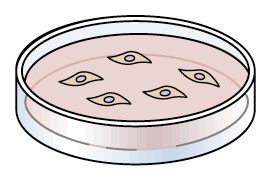
 Multiplicity of infection (MOI) is a frequently used term in virology which refers to the number of virions that are added per cell during infection. If one million virions are added to one million cells, the MOI is one. If ten million virions are added, the MOI is ten. Add 100,000 virions, and the MOI is 0.1. The concept is straightforward.
But here is the tricky part. If you infect cells at a MOI of one, does that mean that each cell in the cutlure receives one virion?
The answer is no.
Here is another way to look at this problem: imagine a room containing 100 buckets. If you threw 100 tennis balls into that room – all at the same time – would each bucket get one ball? Most likely not.
How many tennis balls end up in each bucket, or the number of virions that each cell receives at different MOI, is described by the Poisson distribution:
P(k) = e-mmk/k!
In this equation, P(k) is the fraction of cells infected by k virus particles, and m is the MOI. The equation can be simplified to calculate the fraction of uninfected cells (k=0), cells with a single infection (k=1), and cells with multiple infection (k>1):
P(0) = e-m
P(1) = me-m
P(>1) = 1-e-m(m+1)*
*this value is obtained by subtracting from unity (the sum of all probabilities for any value of k) the probabilities P(0) and P(1)
Here are some examples of how these equations can be used. If we have a million cells in a culture dish and infect them at a MOI of 10, how many cells receive 0, 1, and more than one virion? The fraction of uninfected cells – those which receive 0 particles – is
P(0) = e-10
= 4.5 x 10⁻⁵
In a culture of one million cells this is 45 uninfected cells. That’s why an MOI of 10 is used in many virology experiments – it assures that essentially every cell is infected.
At the same MOI of 10, the number of cells that receive 1 particle is calculated by
P(1) = 10e-10
= 10 x 4.5 x 10-5
= 4.5 x 10⁻⁴
In a culture of one million cells, 450 cells receive 1 particle.
How many cells receive more than one particle is calculated by
P(>1) = 1-e-10(10+1)
=0.995
In a culture of one million cells, 999,500 cells receive more than one particle.
Using the same formulas, we can determine the fraction of cells receiving 0, 1, and more than one virus particle if we infect one million cells at a MOI of 1:
P(0) = e-1 = 0.37 = 37% of cells are uninfected
P(1) = 1 x e-1 = 37% of cells receive one virion
P(>1) = 1 – e-1(1+1) = 26% of cells are multiply infected
An assumption inherent in these calculations is that all cells in a culture are identical in their ability to be infected. In a clonal cell culture (such as HeLa cells) the deviations in size and surface properties are small enough to be negligible. However, in a multicellular animal there are substantial differences in cell types that affect susceptibility to infection. Under these conditions, it is experimentally difficult to determine how many virions infect different cells.
High MOI is used when the experiment requires that every cell in the culture is infected. By contrast, low MOI is used when multiple cycles of infection are required. However, it is not possible to calculate the MOI unless the virus titer can be determined – for example by plaque assay or any other method of quantifying infectivity.
Pingback: Tweets that mention Multiplicity of infection -- Topsy.com
Damn, my first comment has vanished. Anyway…
Good post! – Perhaps this is a place to bring up particle to pfu ratio??? The above is great for when talking about phage, for example, when the ratio approaches 1. But with something like polio when it can be very high (>1000 ??), then it’s not that all cells don’t receive “a particle” at MOI=1 – but that they don’t get an “infectious dose”. Not sure how to say it better – enough to initiate an infection.
So why does polio require 1000 virions to make an infectious dose? I don’t buy the idea that most of the particles are not “viable”.
Your initial formula for the Poisson distribution looks wrong, btw.
Let me know why you think the distribution is incorrect. That formula
has been in virology textbooks for over 40 years, so I didn’t make it
up.
what MOI will result in 50% of the cells being infected (50% uninfected)?
The MOI to infect 50% of cells, or to leave 50% of cells uninfected is
P(0) = 50% = 0.5; therefore m = -ln(0.5) = 0.7.
Prof. Racaniello: I think Alex Ling means the correct formula should be P(k) = e^-m times m^k/k!
Alex is right! I copied it incorrectly from my textbook. It’s now
corrected. Thanks to you and Alex for pointing this out.
Pingback: Are all virus particles infectious?
I want to claim a point we usually forget: Infectious doses, infectious particles, infectious units… are a relative concept as “infectious” depends on the cell type used to run the assay, i.e Vero cells, HeLa cells, BHK21…There is no an unique in vitro system to make a pfu assay for every virus, for instance you can use A9 or NB324K cells to titrate parvovirus MVMp and the same stock will rise a different (but constant) titre on each.
On the contrary the physical particle counts is an absolute value. Then the ratio particles/infectious will depend on the cell system. I agree Dorian that at least for in vitro assays, MOI and infectivity measures not just viable viruses but also specific cell conditions required for the infectious process to proceed.
Let me just set a naïve example. Imagine that a weak interaction between the viral particle (viable, full, complete genome) with a membrane protein prevents the access of a virus to the functional receptor. Then the relative abundance of such sticky protein with the receptor in a particular cell type, is going to dictate the chance of “one viable virus” (infectious) to reach and bridge the receptor. Then the ratio particle/infectious will depend on that protein. A situation that it is likely to vary with every cell type.
Don´t forget: viral titre (except the counts of particles) is an arbitrary and relative value.
Thank you very much Sir
haha
This made everything crystal clear clear! thank you!
Pingback: The Lazarus virus
This is nice
http://www.maysaaelsayed.blogspot.com
Dear Sir,
Thank you for your paper.
I have studied varicella zoster virus. I had determined the titer of virus that follows your guiderline. But now, I have a trouble with it. I do not know how to find MOI. Can you help me to find out it?
Once, thank you very much.
You determine the MOI by adding a certain amount of virus to a fixed number of cells. The MOI is the number of infectious viruses added divided by the number of cells. If you have a million cells in a culture dish, and you add a million PFU, the MOI is one.
nice theme. but it takes a while to load
Dear Sir, I would like to know whether MOI is working when I use TCID instead of PFU.
Thanks in advance.
Dear Sir, I would like to know whether MOI is working when I use TCID instead of PFU.
Thanks in advance.
The answer is yes. No matter how you calculate viral titer, the rules of MOI apply.
 a virus suspension of temperate phage contains 10 to the power 7 partiles/ml. Only 10% of these are cpable infecting bacteria. hundred microlitres of the pahge suspension id mixedc with 1000 bacterials cell, what is the multiplicity of infection
100
10% of 10,000,000 = 1,000,000; 0.1 ml contains 100,000, divided by 1000 bacterial cells = MOI 100.Â
Hi!!!
We have an assumption for monolayer cell line that the m.o.i should be less more in the range of 0.1-0.01 However, for suspension cell infection tit should be of high moi why? sometimes more than one also???any idea?
I was talking about a general assumptions with monolayer infection of virus irrespective of the type of virus used for the infection. Any idea of  working with a suspension cell line like BHK-21 clone 13????????
For those asking how to calculate the MOI with TCID50 values, you only have to multiply your TCID50/ml value by 0,69 to obtain the equivalent virus titer in PFU. (This 0,69 value comes from the Poisson distribution as well) Then, just calculate the MOI as usual!
A phage infects bacteria at a multiplicity of infection (moi) of 0.1. This means that
How is the Poisson distribution affected when infecting in suspension versus adherent cultures? Obviously there are volumetric effects that would hinder the random associationg of virus bumping into the cells. Thanks for your kind assistance.
my apologies for my poor spelling.
What MOI approximately would have a cell in the environment of cells producing 10 000 000 pfu/mL ??
Hi Prof, I want to grow my virus in T75 flask, I want to infect cells at Moi of 1. Do i need to consider total no of cells in the flask at 80% confluency, Or just the no of cells/ml added to flask while spliting?
You have to know the total number of cells in the flask when you infect them. If you know the total number at 100% confluence you can make an estimate of the number at 80% confluence.
Suspension vs monolayer does not matter in calculating MOI as long as volume does not influence attachment, as you suggest. If infection is done in a small volume (eg centrifuge cells from suspension) it won’t be a problem.
Thanks!!!
Hi Profvrr, I was working with TCID50 assay, I read it on 4th day, the titre was 10^6, while on the 5th day it was 10^7. 4th day is stand in my lab. I was standardizing MNT, at 200TCID50. I was checking some reference sera with know titre (Titred at 200TCID50 of same virus in some other lab with different cell line, results read at 5th day). 200TCID killed the cells, so does 20TCID. The titers was not even closer to the reference values.
Continue….. Does the reading on 4th or 5th day has something to do with it, or the use of different cell line????
Sir, since tcid50 and pfu are variable from cell line to cell line and day to day of measurement, is it ok to use real time PCR to quantitate viral titre and calculate m.o.i? i understand its not an assay of infectivity but say for a fresh tissue culture lysate wherein u expect most of the virus to be viable is it ok? is it acceptable for research that is…sounds theoretically correct to me… especially for viruses which are not cytopathogenic or plaque forming… please reply
Hi Prof. I`ve just started studying Statistics. So, if I want to know the MOI that will give me around 10 virus particles/cell in almost all cells, how do I do that? Thanks
Moi to infect 60% or leave 40% uninfected is: 0.4. Is this then 0.9?
m= -ln(0.4) = 0.9? Or did I do that backwards?
I have a phage (phix174) with a titer of 2.5×10^6. The recommended MOI for this phage is 0.1-2.0. I want to titer it up. Can I use a high host concentration (e.g 10^8 cfu/mL) to bring the titer up? Based on the volumes I would use the MOI would be somewhere around 0.01 which theoretically is really low but I haven’t had much luck sticking to the recommended MOI.
Dear Prof,
In my research i need to find effect of MOI, i mean ranges ex. 1, 10, 100, 500 etc, in order to differentiate the bacterial pathogenicity whether bacteria has low moi or medium or high moi. And i got different strains in different moi too (ranges from 0-600 moi) In this case should i use Poisson distribution. Actually what is a purpose of Poisson distribution.
Kindly clarify my doubt. Thanks in advance.
Dear Professor,
Currently we are developing the
procedure of antivirals evaluation that is supposed to be common for several
groups of researchers. After a discussion we appeared not to be able to come
to equivocal opinion and procedure. In my message I would like to kindly ask
you to clarify your approach to evaluation of anti-viral potential of
chemical compounds. Please excuse me in advance that I ask you to explain
obvious things.
We study anti-viral properties of various chemical compounds, in
particular in cell culture. Our primary goal is to determine three
characteristics for each compound. First, 50% cytotoxic dose (CTD50), the
concentration that kills 50% of cells. Second, 50% inhibiting concentration
(IC50), the concentration that kills 50% of virus. Third, selectivity index
(SI), ratio of first to second, the value showing how selectively the given
compound kills virus comparing to cells. The higher SI is, the more
selective and prospective is the compound. The ideal compound should have
low IC50 and high CTD50 to express high selectivity.
The main contradiction is how to calculate (in fact, determine) IC50.
When titrating the virus, we work with decimal dilutions and express the
titer as the highest dilution that causes cytopathogenic effect in more than
50% of cells (TCID50), or, in case of influenza virus, positive
hemagglutination in the wells. Based on the results, we plot virus titer
against drug concentration and calculate the dose decreasing the titer by
50% comparing to virus control (concentration zero).
To do this, we mark the Y axis as 1, 2, 3, 4, 5, etc., meaning that
these values are decimal dilutions of initial material, i.e. logarithms, and
that in fact, they represent number of infectious (or hemagglutinating)
units and should be considered as 10(1), 10(2), 10(3), etc. Therefore, IC50
should decrease the titer twice comparing to control, regardless to the
value of the titer in the control (no drugs), e.g. from 10(6) to
5×10(5), or from 10(5) to 5×10(4), and so on.
If we follow the opposite logic, we consider the virus titer as
absolute, not logarithmic, value. In this case IC50 should decrease it from
6 to three, or from 4 to 2, and so on. In fact, this will correspond in
first case to 1000-fold decrease of virus production and in second case
– to 100-fold, i.e. the same dose – IC50 – will have different
effect. That is why I consider this approach incorrect. Doing so, we will be
wrong in calculating the SI because CTD50 will decrease the number of cells
twice (by 50%) while IC50 will decrease the amount of virus by 99,9 (or
99)%. In this case the selectivity is based not on properties of a given
compound but on different approaches to cells and virus.
I will appreciate very much your opinion and clarification. Thank you in
advance.
Sincerely yours,
Vladimir V. Zarubaev, Ph. D.
I understand that if I want to infect a given % of cells I can use the above distribution to calculate the MOI that I must use. But if I determine the % of cells that are infected experimentally then mathematically how do I determine the MOI that must have been added to those cells to result in the experimentally determined infected %? I hope then to calculate back the number of cells that were in the dish and thus determine titre….?
Can anyone please help? I have been trying to figure this out and my brain is going to explode!
Pingback: Viral variation in single cells
You could have harvested a large enough volume of cell suspension, obtained a count, and have adjusted the concentration to whatever MOI you want at the time of infection.
In considering multiplicity of infection, is there a volume parameter? It seems to me that a million cells in a culture of a million particles will yield different infection rates in different volumes (100 uL, 1 mL, 10 mL). Are MOI’s standardized by volume parameters?
::clapping my hands::
Nice. I asked myself the same question a couple of years ago and tried it out with lentivirus. I found that with a consistent MOI, volume was inversely proportional to infection rate (more concentration => more infection). If you keep other variables consistent within your protocol and only ever change the amount of virus, then you’d never notice it. But you are correct, there is an unspoken or assumed standardization of volume, which perpetuates the use of MOI in textbooks and official protocols.
hye prof. i need your opinion. i want to infect RAW cells with newly came MNV. the supplier didnt mention the titre but suggest to use MOI between 1-10. so, i quite confuse wther to use low or high MOI because as i understand, low MOI will give greater titre as we reduced the chances of defective particles to infect the cells. The suggested incubation for stock preparation also around 2-3 days. so if i use MOI 1, is it 1 virus particle per cell. so when all cells infected, so no host anymore for newly produced progeny. then the titre will drop significantly. do u have any suggestion?
Plz elaborate the calculation