
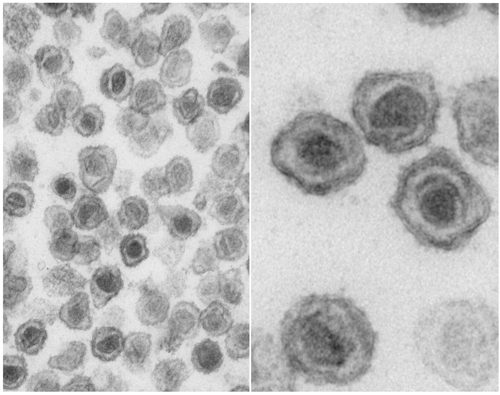
 A strong argument that the novel human retrovirus XMRV is not a laboratory contaminant is the finding that viral DNA is integrated in chromosomal DNA of prostate tumors. Why does this result constitute such strong proof of viral infection?
Establishment of an integrated copy of the viral genome – the provirus – is a critical step in the life cycle of retroviruses. Proviral DNA is transcribed by cellular RNA polymerase II to produce the viral RNA genome and the mRNAs required to complete the replication cycle. Without proviral DNA, retroviral replication cannot proceed.
To produce proviral DNA, the retroviral RNA genome is converted to a double-stranded DNA by the viral enzyme reverse transcriptase. This step occurs in the cytoplasm. Speciï¬c and efï¬cient insertion of the viral DNA into the host cell DNA is catalyzed by a viral enzyme called integrase. This enzyme recognizes and nicks the two ends of viral DNA, and the new 3′-ends are then joined covalently to the host DNA at staggered nicks made by integrase.
The image below shows some of the characteristic features of retroviral integration. A the top is the unintegrated linear DNA of avian sarcoma/leukosis virus produced by reverse transcription. Upon completion of integration, two base pairs (AA€¢TT) are lost from both termini, and a 6-bp target site in host DNA (pink) is duplicated on either side of the proviral DNA. This target site varies in length from 4 to 6 bp among different retroviruses. The proviral DNA (middle) ends with the conserved 5€²-T G€¦C A-3€² sequence. The provirus serves as a template for the production of the viral RNA genome (bottom).
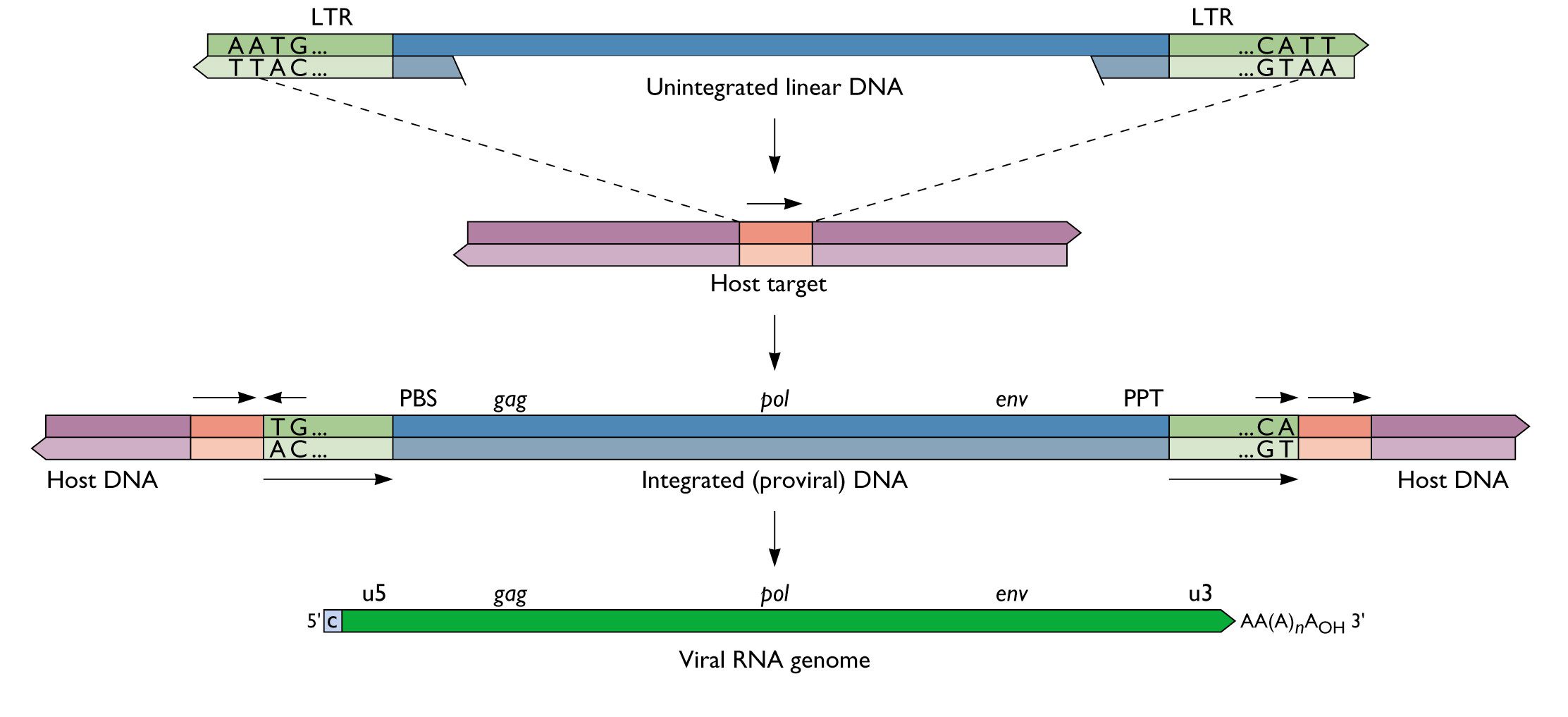 To identify XMRV proviral DNA, genomic DNA was isolated from prostate tumors, and DNA was amplified using a primer that annealed in the viral env gene, near the right-hand LTR. Nucleotide sequence analyses of amplified DNAs from
 14 9 different patients showed the expected viral CA sequence followed by human DNA. However, the other cardinal sign of retroviral integration – duplication of host DNA sequences flanking the integration site – could not be confirmed, because only the right-hand integration site was studied.
The isolation of the entire proviral DNA, including both flanking integration sites, from patients with prostate cancer or chronic fatigue syndrome would be additional evidence that XMRV is a virus that infects humans.
Kim, S., Kim, N., Dong, B., Boren, D., Lee, S., Das Gupta, J., Gaughan, C., Klein, E., Lee, C., Silverman, R., & Chow, S. (2008). Integration Site Preference of Xenotropic Murine Leukemia Virus-Related Virus, a New Human Retrovirus Associated with Prostate Cancer Journal of Virology, 82 (20), 9964-9977 DOI: 10.1128/JVI.01299-08
Question: why isn’t it harmful to retroviruses to lose the 2 bases during integration?
Pingback: XMRV Buzz! The CFS/XMRV News Page
I have double stranded dna and recently diagnosed with renal cell cancer,It has been hell, I am glad this horrible experience is almost over,
Good question. Those two bases are restored during copying of viral
RNA (produced from the integrated provirus) into DNA, during
infection. Otherwise the viral DNA would always be losing two bases
and eventually become noninfectious.
Having a ‘mental illness’ can still make you extremely ill, and be life threatening in some cases. A mental illness is still most definitely a real illness (as is CFS, whatever it is).
Pingback: XMRV is a recombinant virus from mice
Thanks for the studies , formal or independent, on this retrovirus. It is understandable that you do not publish or formally research in this area. many who have attempted to link retroviruses to CFS have lost their careers, not a help to any cause.Â
As a 30 year CFS patient who has been treated by the best in the country and done my own extensive work, I advise patients to take the same tack as health professionals, avoid CFS.   There is no common direction or treatment protocol. Find a good alternative professional, who thanks to the inept work of the CFIDS Assoc will likely never have heard of CFS, then educate that clinician with your own personal medical history, symptoms, and your own related CFS research. Unless you want the same runaround you got from standard medicine, do this your self, it is the only way you will get anything done. By getting anything done, I mean basic symptomatic relief.Â
There is no cure, no diagnosis, no clues, no answers, no common consensus or direction, no help from CFIDS Assoc or from standard and alternative medicine. Find a good alternative practitioner with knowledge of the immune system , and work with him on your pain and symptoms. Try the Swank diet for MS, eliminating all major allergens which further irritate the immune system.  Stay away from ENT’s, the absolute worst of conventional medicine.
 CFS is only one of a large number of undiagnosed “orphan diseases” which fall under the heading of polyendocrine autoimmune disorders, caused by living in a toxic environment of chemicals, radiation, and electromagnetic waves. These conditions lead to disordered immune systems, and susceptibility to retroviruses, among other stressors. To prevent and “cure” these diseases, someone would have to take on the chemical and electronics industries, the banks, insurance companies, and the GOP. As we have recently seen to be demonstrably proven, this will never happen. Take care of yourself, and do your own research.Â
Tylenol is poison, for profit. Find an enlightened professional who is not afraid to prescribe real pain relief for suffering patients.Â
Stop wasting your time arguing with anyone about causes of CFS, it goes nowhere, leads to no treatment or cure, or relief. Treatment for retroviruses is a long way off. It took threat of a global pandemic to get any work done on HIV. Yeah, I’d sure like to know also, after 30-60 years of this. I’d like a fair world too. Rather have half a life and some relief though. Research your immune system and common stressors, eliminate them and get some relief. Leave politics to politicians. In this world, medicine is politics, just as everything else.Â
Â
Who is to say, at this point , which diseases originate in the “mind” , then causing physical harm to the body, and which are physical trauma that subsequently causes a mental disorder?Â
 If a person undergoing “enhanced interrogation” involving physical contact becomes permanently unhinged mentally, is that a real mental illness, or a real physical illness? Does that depend on whether there are measurable physical or chemical changes in the brain? If we can’t measure them but they are present, is it a physical or mental illness?  If a person under “enhanced interrogation” is never touched, but is subjected to a non-physical stress environment which causes physical and chemical changes in the brain, is that a mental or physical illness?Â
Chemicals are “real”, electrons are “real”. Science recognizes nothing else comprising the brain or “mind.”  There is no “ether” or magic fairy dust.  Mind is chemicals and electrons. Anything else is a false dichotomy and a distraction, in my lay opinion. Categorization is useful and necessary, false labeling is not. Let us begin to separate science from superstition, folklore, and religion. It is about time.Â
I TESTED POSITIVE TO A PIECE OF THE AIDS VIRUS WITH PIECES OF OTHER MATERIALS ATTACHED… I TEST NEGATIVE TO HIV NORMAL TESTING USED IN AIDS BUT I AM POSITIVE TO 45% OF THE HIV VIRUS ENVELOPE….ALL OF YOU OUT THERE CONTINUE TO FIGHT ABOUT XMRV THIS AND XMRV THAT…YOU ARE ALL WASTING YOUR TIME BECAUSE A PIECE OF THE HIV VIRUS IS THE CAUSE…IF ANY OF YOU ALSO BELIEVE HIV STARTED IN MONKEYS IN AFRICA YOU ALL NEED TO GIVE YOUR HEADS A GOOD SHAKE…HIV OR CALL IT WHAT YOU LIKE IS A SYNTHETIC VIRUS CREATED IN A U.S MILITARY LAB BY THE SAME PEOPLE WHO SPREAD CFIDS ACROSS THE GLOBE IN NUMEROUS VACCINES AND OF COURSE OTHER METHODS… DID ANY OF YOU KNOW THAT THE AMERICAN GOVERNMENT SOLD A PIECE OF THE HIV VIRUS TO SUDDAM TO USE AGAINST THE IRANIAND DURING THERE 10 YEAR WAR AND HE WARNED AMERICA NOT TO ENTER THE DESERT BECAUSE THERE WOULD BE A ‘SURPRISE’…WHY NOW DO WE HAVE ANOTHER ‘LABEL’ DISEASE CALLED GULF WAR SYNDROME AND SUDDAM GAVE THEM ALL A PIECE OF THE AIDS VIRUS WHICH RAIN DOWN IN SCUD MISSILES PURPOSELY EXPLODING IN THE AIR ABOVE THEM AND RAINED DOWN ON THEM…ALSO HE FLOODED THE WATER WITH BIOLOGICALS AND HE MADE SURE HE USED SPRAY TRUCKS TO CONTAMINATE THE DESRT FLOOR…HOW CAN PATIENTS BE AS SICK AS HIV/AIDS PATIENTS ARE AND THE SOLE ANSWER IS 45% OF THE HIV VIRUS ENVELOPE…OF COURSE ALL OF YOU CAN GO ON AND ON ABOUT XMRV BUT IF ANY OF YOU WANT TO TRY AND GET WELL THEN DO NOT LISTEN TO ALL THE B.S. OUT THERE AND LOOK FOR THE FULL TRUTH….    ‘I AM POSITIVE TO 45 % OF THE HIV VIRUS ENVELOPE’ AND THAT IS A FACT’
NICE PROFVRR THAT YOU WORK ON OTHER VIRUSES AND YOU REPORT ABOUT THEM, WELL JUST TO LET YOU KNOW SINCE THIS HERE IS TALK OF XMRV…I HAVE CFS AND I HAVE BEEN SERIOUSLY ILL SINCE JUNE OF 1990 AND PEOPLE NOW KEEP GOING ON ABOUT XMRV THIS AND XMRV THAT…I HAD MY BLOOD DRAWN BY A REPUTED WORLD RENOWNED SCIENTIST AND DO YOU HAVE ANY IDEA OF WHAT I TESTED POSITIVE FOR? I TESTED POSITIVE TO 45% OF THE HIV VIRUS ENVELOPE AND ON OTHER NORMAL TESTS FOR THE HIV WORLD SCREENING BLOOD TEST I AM NEGATIVE TO HIV IN COMMERCIAL LAB SETTINGS… I AM SICK TO THIS DAY NOT FROM EBV, NOT FROM HHV-6, NOT FROM XMRV BUT A PIECE OF THE AIDS VIRUS THAT WAS ON PURPOSE GIVEN TO US TO MAKE US ALL SICK….I AM GLAD YOU ARE A REPORTER…
Pingback: Your Questions About What Is Virus Envelope | Data Protection Virus
Mycoplasma Fermentans Incognitus. Mutated Brucella inserted into the outer shell of the visna virus. There is a DoD patent on it too.
Pingback: Spread of koala retrovirus in Australia