
 On my recent trip to record TWiV #111 at Florida Gulf Coast University, I visited Rich Condit in Gainesville. There he told me a story about how the bacteriophage T7 polymerase/promoter system was developed. It’s an interesting tale that demonstrates how important scientific advances often have convoluted roots. You can watch the video below or download a high-definition (720p) version (585 MB .mov).
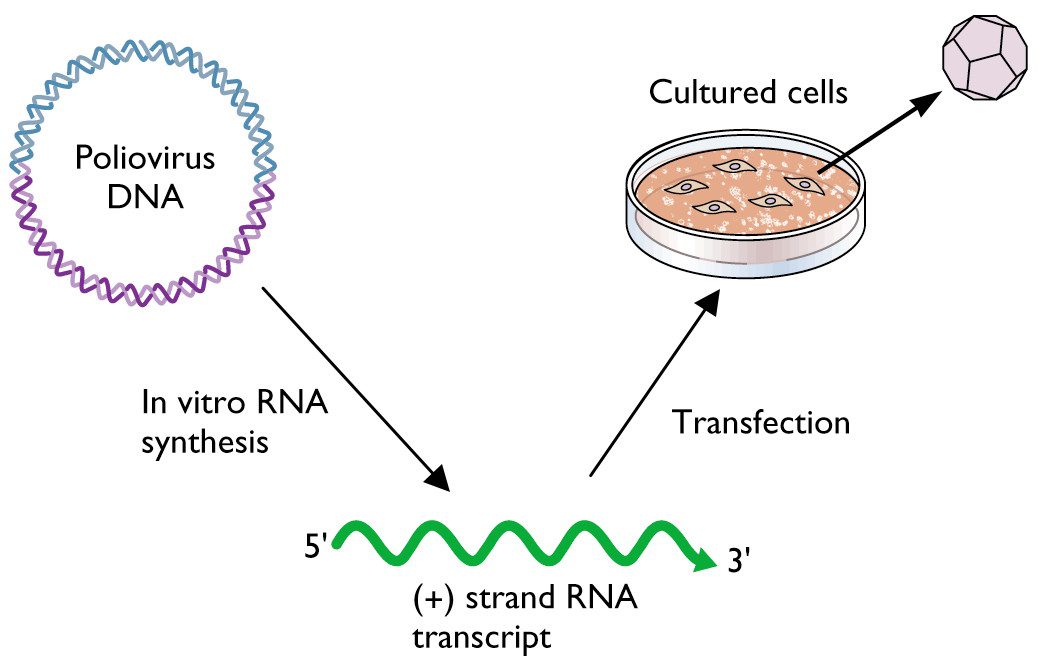
The combination of bacteriophage T7 RNA polymerase and its cognate promoter sequence allows the production of specific RNAs either in vitro or in cells. In many laboratories this system is used to synthesize infectious viral RNA from cloned DNAs. In the example shown, a DNA copy of of the poliovirus RNA genome has been cloned into a bacterial plasmid. The promoter sequence for T7 RNA polymerase is inserted at the 5′-end of the viral sequence (not shown). When placed within any double-stranded DNA, this 19 nucleotide promoter sequence (TAATAGGACTCACTATAGG) will lead to the production of RNA. The plasmid is incubated with purified T7 RNA polymerase (commercially available) and ATP, GTP, UTP and CTP, and the viral RNAs that are produced are then transfected into cells. A viral replication cycle begins, resulting in the production of infectious virus particles.
As described by Rich in the video below, this expression system was conceived by Ed Niles and brought to practice by Bernard Moss. The first paper published described the insertion of the gene encoding T7 RNA polymerase into the genome of vaccinia virus. When cells are infected with the recombinant virus, they produce T7 RNA polymerase. To express a protein using this system, a gene is cloned into a plasmid next to the T7 RNA polymerase promoter. When this plasmid is introduced into cells producing T7 RNA polymerase, RNAs are made which are then translated into protein.
This method was subsequently modified by Wimmer and colleagues to synthesize infectious poliovirus RNA in vitro.
Werf, S. (1986). Synthesis of Infectious Poliovirus RNA by Purified T7 RNA Polymerase Proceedings of the National Academy of Sciences, 83 (8), 2330-2334 DOI: 10.1073/pnas.83.8.2330
Fuerst, T. (1986). Eukaryotic Transient-Expression System Based on Recombinant Vaccinia Virus that Synthesizes Bacteriophage T7 RNA Polymerase Proceedings of the National Academy of Sciences, 83 (21), 8122-8126 DOI: 10.1073/pnas.83.21.8122
Pingback: Tweets that mention Rich Condit reminisces #research -- Topsy.com
Just to set the record straight on who did what when:
In my reminiscence I make the statement that Ed’s and my in vitro translational mapping experiments (Niles EG, Condit RC. (1975) J Mol Biol. 98, 57-67) uncovered the T7 transcription signals that were used in subsequent expression vectors. While it is true that these experiments mapped several T7 promoters and terminators, and in particular revealed that the T7 coat protein gene 10 was the only monocistronic late gene with its own very hot promoter and terminator, this work and the work of others (Golomb M, Chamberlin M. (1974) Proc Natl Acad Sci USA 71, 760-4) only pointed the way, and the detailed characterization of T7 transcription signals was done by others subsequently (Rosa, M. D. (1979) Cell 16, 815-825; Panayotatos, N. & Wells, R. D. (1979) Nature (London) 280, 35-39; Dunn, J. J. & Studier, F. W. (1983) J. Mol. Biol. 166, 477-535). Also, the use of T7 RNA polymerase and its transcription signals for expression of foreign genes in bacteria was introduced prior to the vaccinia/T7 system (Tabor, S. & Richardson, C. C. (1985) Proc. Natl. Acad. Sci. USA 82, 1074-1078; Studier, F. W. & Moffat, B. A. (1986) J. Mol. Biol. 189, 113-130). The vaccinia/T7 system was a novel application of this concept that has proven of significant value for expression of proteins in eukaryotic cells.
Lastly, I make the statement in my reminiscence that Joan Steitz never did the T7 ribosome binding experiments. This turns out to be wrong. I discovered doing the research for this comment that those experiments were in fact done by Margaret Rosa, who was working with Joan Steitz (Rosa MD.( 1981) J Mol Biol. 147, 55-71). Joan has had a most generous tradition of leaving her name off of papers where she felt that her contribution was minimal.
-Rich Condit
Hey guys,
so do the T7 transcripts get capped in vaccinia infected cells? I recall from somewhere that putting an IRES sequence in the 5′ UTR increases translation efficiency of those transcripts – but that doesn’t mean that some isn’t capped.
I don’t believe that anyone has actually looked to see if the T7
transcripts are capped – this is not an easy experiment. There is a
low level of protein synthesis from T7 transcripts but these need not
be capped. I’m not sure why you would expect the vaccinia capping
enzyme to work with T7 RNA polymerase. Rich?
I wouldn’t expect the Vaccinia capping enzyme to work “properly” with the T7 RNA polymerase, but a little capped mRNA might give low level protein in the same way a lot of uncapped mRNA might give low level of protein because of very poor translation initiation.
Chris is right. Capping is thought to be coupled to transcription in a virus enzyme specific manner during pox infection, so one would not expect the T7 mRNAs to be efficiently capped. In fact this has been measured, and only 5-10% of the T7 messages are capped (http://www.ncbi.nlm.nih.gov/pubmed/2497259). Vectors nowadays include an IRES element between the T7 promoter and the translation start site, thus promoting cap independent translation and avoiding this problem. Also, the T7 transcription of robust, so translation does not have to be very efficient.
April 15, 2011 – I had the pleasure today of visiting Brookhaven National Laboratories and meeting with Bill Studier for the first time in over 20 years. As I kind of suspected, I got some of his pre-T7 history messed up. He did his graduate work at Cal Tech (not with Normal Davidson), and a postdoc at Stanford. It was at Stanford that he did the physical chemical measurements on DNA and it was not banding in CsCl but rather sedimentation studies. Oh well, I was close. Not too bad given that I read the papers as a graduate student 35 years ago and probably didn’t really understand them.
It was wonderful to see Bill. He and his work have shaped my career significantly, and he has made enormous contributions to biology. He is a fine scientist and a warm and generous person.