
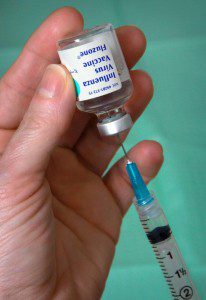
 The World Health Organization and the US Food & Drug Administration have decided on the composition of the influenza virus vaccine that will be used during the 2010-2011 season in the northern hemisphere. The trivalent preparation will contain the following influenza virus strains: A/California/7/2009 (H1N1); A/Perth/16/2009 (H3N2); and B/Brisbane/60/2008. The same trivalent vaccine is also being used to prepare for the upcoming winter in the southern hemisphere.
The A/California/7/2009 (H1N1) virus is the pandemic strain that was used in the 2009 H1N1 monovalent vaccine. That virus has not yet undergone sufficient antigenic drift to warrant selection of a new strain for the vaccine. Note that a seasonal H1N1 strain from previous years will not be included in the vaccine. This change has been made because epidemiological evidence suggests that these viruses will probably not circulate at significant levels during the 2010-2011 northern hemisphere season. Although the vast majority of circulating influenza viruses in humans are related to the 2009 H1N1 pandemic strain, sporadic influenza A(H3N2) activity continues to be reported in several countries. This is the reason why an H3N2 component is part of the vaccine.
The selection of viruses for seasonal flu vaccines is based on which influenza viruses circulate during the previous season. Sample viruses are collected by 130 national influenza centers in 101 countries and data on disease trends are analyzed by the four World Health Organization (WHO) Collaborating Centers for Reference and Research on Influenza. Vaccine viruses are selected which will most likely protect against the main circulating viruses during the next influenza season. WHO makes recommendations about which specific virus strains should be included in the vaccine. Individual countries then decide which viruses will be included in the influenza vaccine.
Even though the 2009 H1N1 strain has not undergone significant antigenic changes, it’s important to be immunized again in anticipation of the next influenza season. That’s because immunity conferred by the vaccine isn’t particularly long lasting. As Adolfo Garcia-Sastre told me today*, even if influenza didn’t change, you would still have to be immunized every year to protect against infection.
*I recorded our conversation. Look for it at TWiV within the next few weeks.
So why is killed-polio vaccine able to give longer lasting immunity than this flu vaccine?
Terrific question. A good one for a virology exam! Basically the
inactivated flu vaccines don't induce immune memory – and why that is
isn't known. One issue might be the fact that the virions in the
vaccine are disrupted with detergent, and therefore barely resemble
infectious virions. Or the absence of internal virion components might
play a role. The inactivated poliovirus vaccine, on the other hand, is
not disrupted – the virions are largely intact, and that might
contribute to inducing robust memory.
I wish I knew more immunology.
So what is inducing “memory”? We're getting a response… enough Abs to protect, why no memory cells?
How well has this been tested?
We always assume we need a new vaccine because of drift.
Since I've had a few flu shots over the years, I'm not terribly worried if I occasionally miss one (unless different viruses.
I think that's part of it, but not the whole story. The inactivated flu vaccine does give a memory response, but it's relatively short-lived, a year to a few years. But even the live flu vaccine (the cold-adapted virus) gives a relatively short-lived response as well — longer than the inactivated version, but not spectacularly so.
So is it something intrinsic to influenza? (It's not impossible — for example, noroviruses tend to only induce very short-lived immunity, so this is something that viruses may be able to manipulate a little.) But we do know that anti-flu immunity can last a very long time. Remember the paper a couple years ago that showed immunity in modern survivors of the 1918 flu, 90 years later.
On the third hand (we need a squid to debate this properly), that's not directly comparable, because they weren't measuring the same thing in that study. They were restimulating first and then looking for the memory. In general, detection of long-lasting memory has taken that approach, because antibody titers decay away fairly quickly (unless there's restimulation in vivo) even when memory cells are present. I don't know of studies where that's been done with the flu vaccines (doesn't mean the studies aren't out there, just that I don't know of them) — how much memory is left after the antibody titers wanes, and how recoverable is that memory?
I also don't know how directly comparable the polio studies were — were they picking up circulating antibody in the absence of restimulation (the flu situation) or restimulating in the process and picking up on the memory response from reactivated memory cells?
But yeah, the disruption is probably a big part of it. Better innate triggers from the incorporated RNA and probably virion proteins. Probably better CD4 help as well (particulate material, perhaps including virions, is better phagocytosed and presented on MHC class II for T cell help than is soluble protein). Giving a more potent adjuvant with the flu vaccine (the emulsion that's used in Europe) does lead to a longer-lasting response, as I recall.
The live vaccine for flu is mucosal which tends to have less long-lasting memory in general, though it's not universally true. So I'm guess the short antibody response to the inactivated and the live vaccines are for different reasons.
I also wonder how much impact pre-existing cross-reactive immunity to other flu strains would have. I'd be surprised if there was no effect at all from our annual exposure to different strains, and I'd guess that would tend to reduce the effective dose of the flu vaccine compared to polio, and might lead to amplification of the “wrong” (cross-reactive but non-neutralizing) response.
Mostly guesswork, I'm afraid. Sorry for the stream of consciousness rambling.
Thanks for those great comments. Your point about the adjuvant is correct: Adolfo mentioned yesterday that adjuvants would probably be useful for a longer-lasting response.
Pingback: Trivalent influenza vaccine for the 2010-2011 season | H3N2FLU.US
Pingback: Trivalent influenza vaccine for the 2010-2011 season | H1N1INFLUENZAVIRUS.US
Please help I need 5 vaccines a.s.a.p – South Africa
Please help I need 5 vaccines a.s.a.p – South Africa
I am a high risk patient and can't find anywhere that has the flu vaccine available. Can anybody please tell me where I can find a clinic or private practice that might still have stock. If I die of this flu virus, can my family sue the government??? Apparently, although I suffer from asthma I was shown the door at a government clinic. They told me to go elsewhere and said they didn't have stock although I know of people that got their vaccines at the same clinic. What is happening to this country???
Pingback: Seasonal, H1N1 flu vaccine to be combined this fall
Pingback: Seasonal, H1N1 flu vaccine to be combined this fall | Sovereign Independent
Pingback: Militant Libertarian » Seasonal, H1N1 flu vaccine to be combined this fall
Pingback: FreeWestRadio.com » Blog Archive » Seasonal, H1N1 flu vaccine to be combined this fall
I'm not taking this vaccine , there is no way to know for sure what is actually in these things ???
iayork gave very lucid comments . General internet queries weren't getting me results
so i am posting my direct question:
I am a mostly healthy 59 year old with Type II diabetes, controlled with diet and exercise.
Because of this risk factor i was given the current flu vaccine: Seasonal + H1N1. ( don't know whether that is the trivalent vaccine under discussion, and that might not even be germane to my question.
I was vaccinated 9/22. On saturday 9/25, I was exposed to my 22 month old grandson's cold. Yes, Grandma wiped his snotty nose multiple times with no hand washing or sanitation in between. Cold symptoms appeared 9/26 with a scratchy throat , working it's way through a runny nose alternating with breathtaking ( literally ) congestion, body aches, extreme fatigue, hacking coughs and ferocious sneezes. Not much fever. Symptoms have shifted and alternated without any real progress to recovery – it is now Thursday Sept. 30, 2010.
This is the most severe cold i can remember experiencing in several years.
QUESTION: Is it possible that there has been some interaction/ synergy between the cold and the flu vaccine to have exacerbated my misery.
Thanks for taking time to answer.
I wouldn’t suggest getting this Vaccine, I just got it with my family, and they had mild hallucinations, and it was awkward for me.
We got flu shots in October in Texas, and now my son has Type A flu…..hmmmm….how does this happen
It takes 2-3 weeks for the influenza vaccines to induce immunity; if
you encounter the virus before that time, infection will occur. Also
remember that the vaccine is not 100% effective – the inactivated
influenza vaccine is 70-90% effective at preventing influenza in
adults. The numbers are similar in children. Not everyone who receives
influenza vaccine will be protected against influenza.
we should not take this vaccine beczuse we dont know that what are the symptoms and reactions after administration of this vaccine…
italiya bhavesh
You suffered placebo effect.
What is in it? As the article states: inactivated (dead) virus designed to provide you with immunity from these strains of flu.
What do you think might be in it?
Regardless of the names given to the various strains of influenza (H1N1/H5N1 etc etc) I think it should be remembered that they come under the heading Influenza type ‘A’ and this includes avian/bird flu, swine/pig flu, and human strains of flu.
All viral organisms travel within the cells of the body via an enzymatic process, namely they secrete the enzyme neuraminidase which breaks down the cellular membranes to facilitate proliferation. Therefore any medicines or supplements aimed at retarding this process can be potentially valuable. Various herbal agents are capable of inhibiting this enzyme (one such being Poke root-check the dosage out with a trained Medical herbalist!), another is star anise which has been extensively utilised by the drug companies to manufacture the antiviral product ‘Tamiflu’ (using the spice in hot water as a tea has the same effect), Vitamin D3 has also been found to inhibit the same enzyme and most branches of medicine now recognise a general tendency for people to be deficient in this, so supplementally this too can be useful.
Whilst I don’t think most people are in principle against the concept of immunisation, particularly against the more serious diseases, I would like it explained to me by the pharmaceutical manufacturers of these flu vaccines just why some of the highly toxic ingredients are actually necessary or seen as appropriate to inject into the human body!
For example this ‘seasons’ cocktail includes mercurial compounds (in any shape or form mercury is highly toxic), formaldehyde (used in the manufacture of timber products), detergents, squalene, probably several others too including pig DNA (pig cell lines are used in the manufacturing of the swine flu vaccine -for what possible reason I cant imagine). Carrying agents for these vaccines could be as simple as arrachis oil which is successfully used in other intra-muscular injections.
There is a great deal of controversy over these modern vaccines and I would have thought by now it could have been better explained to the population at large just why the selected ingredients are being included, how they work, exactly why pig cell lines/DNA is being included (seems a sure-fire way of causing ‘cross-species’ infections?).
In short it’s time to come clean with people and stop all the scare mongering and fear tactics. Yes every year people do die from flu, and always have done. This is not acceptable if safe ways can be found to protect people but first and foremost we all need to pay particular attention to our immune systems-this is our first line of defence against all manner of pathogens, not drugs and vaccinations.
I am not a virologist, I have been a Registered Medical herbalist for twenty years and I have studied disease patterns and immunology. I would simply urge those allopathic corporations to properly inform the public from an unbiased standpoint as to what their intentions are with our health. I would like to believe their motives are in our best interests but do us all a favour and first stop the scare tactics!
Pingback: Clinical Trial Underway for Seasonal/H1N1 Vaccine | Science Business
Nothing in a vaccine can cause hallucinations. Vaccines donot contain narcotic substances.
Influenza is incurable. Only a fool would not get immunized. I suggest get every vaccine offered.
Most cost from 25 to $50 each. If you get even one of the diseases, it will cost you more in missed-work, office visits, and futile prescription drugs than all of the vaccine costs combined especially if you also infect your friends, co-workers, and relatives/family….Al-
absolutely spot on sir.I would not have one of these “vaccines” for love nor money.The fact that mercury is used in them as a “preservative” is beyond comprehension,whilst we are at it,why not lets inject us all with a tiny ammount of the AIDS virus so we cannot contract that.Furthermore,why not just spray it into the air,oops,wait,i think they have already done that.
your better off without it sir.
Pingback: H3N2v: How a New Swine Flu Virus Could Complicate Influenza Season | Healthland | TIME.com
Pingback: Flus.us » Blog Archive » New Swine Flu Virus Could Complicate Influenza Season » Flus.us
Pingback: New Swine Flu Virus Could Complicate Influenza Season | Believe Me When I Tell You
Pingback: New Swine Flu Virus Could Complicate Influenza Season – شبكة النيل الإخبارية
Pingback: How a New Swine Flu Virus Could Complicate Influenza Season | Flu Symptoms, Treatment, Cold, Stomach, Swine Flu
Pingback: New Swine Flu Virus Could Complicate Influenza Season | Stop Spam Tips
Pingback: New Swine Flu Virus Could Complicate Influenza Season - TIME / Tactical Paracord
 And a direct attack against pharmaceutical companies with the use of statements such as, “I would like it explained to me by the pharmaceutical manufacturers of
these flu vaccines just why some of the highly toxic ingredients are
actually necessary or seen as appropriate to inject into the human body” isn’t a scare tactic? While our immune systems are our “first-line of defense” in an elderly adult or a young child, this defense isn’t always as strong as we’d like it, hence the deaths. Also these deaths that occur, occur in a much more densely in third world countries and countries with in-capabilities of proper medicinal distribution! But sometimes people, and their immune systems, need a little bit more assistance, and assistance i mean in a literal term, in combating the infection, than the help given by a tea leaf or a plant root. All vaccines do is assist the body in priming itself for faster action in combating the infection, and this is much better for all ages than Herbology. I’m not saying Herbology is wrong, i’m saying it’s not the ultimatum. And to convince people to cease taking preventative measures other than the measures you believe in could be more detrimental to the overall treatment of this virus. Statements like that lead to the common belief that anything pharmaceutical destroys our bodies, and that belief is dangerous and destructive, and if your really have studied what you state to have studied you would understand why.