
When will the 2009 swine-origin influenza virus become a seasonal strain? While prediction is very hard, especially of the future (at least according to Yogi Berra), examining past pandemics can be informative.
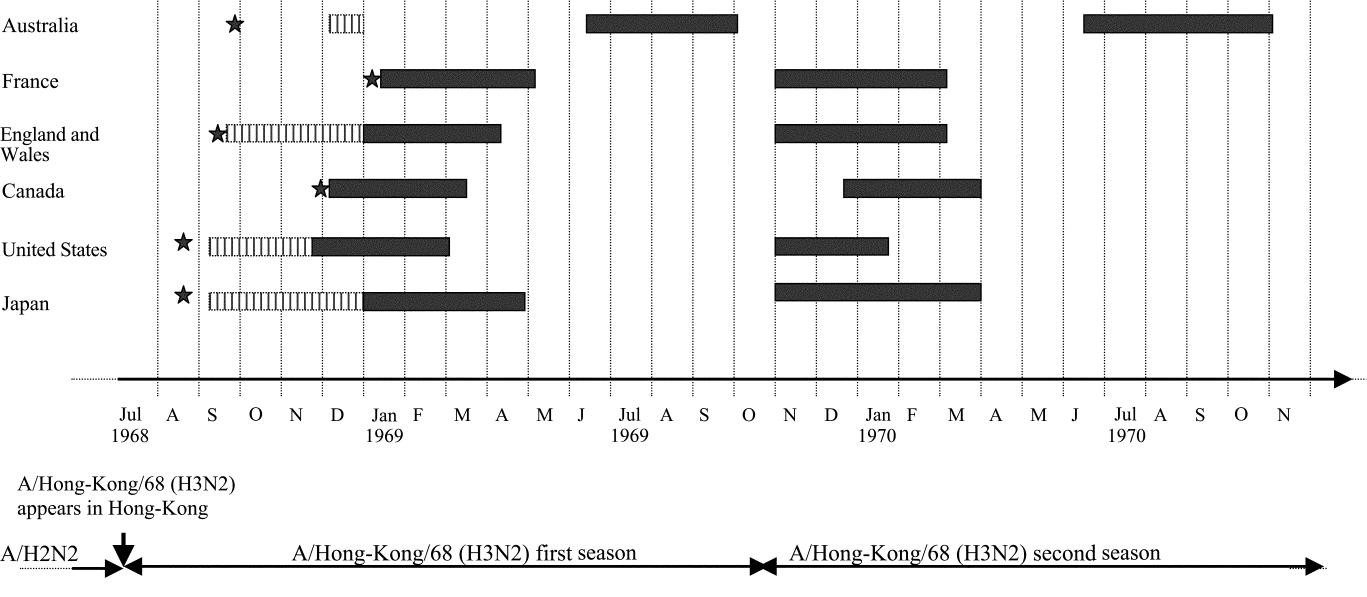
The 1968 pandemic began with the emergence of a novel H3N2 influenza virus in Hong Kong in July 1968. First isolates (stars) were obtained globally throughout the summer. The previous seasonal H2N2 strain was last isolated in August 1968 in Australia and was subsequently not seen again. There were sporadic H3N2 outbreaks for several months (hatched lines). Epidemic spread (solid lines) ensued in the northern hemisphere throughout the winter, and then ceased in the spring of 1969. In the southern hemisphere the first epidemic occurred from January through October. There were second seasons of epidemic spread in both hemispheres, ending in the summer of 1970. After that time the H3N2 strain became a seasonal strain, causing local epidemics each year as the virus underwent antigenic drift.
If the pattern of H3N2 serves as a guide, we might predict that the 2009 swine-origin H1N1 virus will display pandemic spread for at least one more season. In the northern hemisphere, the second season would comprise November 2010 – April 2011. However, immunity in older individuals might blunt the spread of the virus beyond the current first season. It also remains to be seen how much immunization will impact pandemic spread.
At one point the 2009 H1N1 swine-origin influenza virus will become a seasonal strain, and the monovalent vaccine will no longer be produced. At that time the season influenza vaccine will likely comprise a ‘drifted’ version of the 2009 H1N1 strain and an influenza B virus. By all current indications the previous seasonal H1N1 and H3N2 strains will soon disappear from humans – although not from the globe.
Viboud, C., Grais, R., Lafont, B., Miller, M., Simonsen, L., & , . (2005). Multinational Impact of the 1968 Hong Kong Influenza Pandemic: Evidence for a Smoldering Pandemic The Journal of Infectious Diseases, 192 (2), 233-248 DOI: 10.1086/431150
Pingback: Whither 2009 H1N1? | Attention to health
I prefer to compare it with 1977, which was also mild, attacked the children
and was also H1N1 with 8 new segments
62 comments 0 likes 2 points
As you know, the 1977 H1N1 virus had circulated in the 1950s and
probably came from a laboratory in 1977. Many virologists do not
consider the 1977 virus to be a true pandemic strain.
Pingback: [Crof's H5N1] Whither 2009 H1N1? | Influenza Virus Mashup
Are you sure that the 2009 A(H1N1)v is a true pandemic strain? Actually, it shows characteristics that seem unexpected in an influenza pandemic virus. Clinically, the current influenza is milder than pandemics observed in the past. Moreover, the virus is not the consequence of a shift, i.e. there was no emergence of a new subtype. Perhaps the current pandemic definition would be revised. What do you think about the recent article by Peter Gross (Clinical Evidence, 02.11.2009)?
http://clinicalevidence.bmj.com/downloads/02-11…
I always assumed that pandemic strains solely resulted from the introduction of a new HA in the gene pool (not necessarily the introduction of a new subtype).
That this h1n1 strain is not considered a full-fledged pandemic influenza virus by virologists came as quite a shock to me.
> the previous seasonal H1N1 and H3N2 strains
> will soon disappear from humans – although not from the globe
survives in swine ??
Pingback: Tweets that mention Whither 2009 H1N1? -- Topsy.com
I prefer to compare it with 1977, which was also mild, attacked the children
and was also H1N1 with 8 new segments
62 comments 0 likes 2 points
As you know, the 1977 H1N1 virus had circulated in the 1950s and
probably came from a laboratory in 1977. Many virologists do not
consider the 1977 virus to be a true pandemic strain.
Are you sure that the 2009 A(H1N1)v is a true pandemic strain? Actually, it shows characteristics that seem unexpected in an influenza pandemic virus. Clinically, the current influenza is milder than pandemics observed in the past. Moreover, the virus is not the consequence of a shift, i.e. there was no emergence of a new subtype. Perhaps the current pandemic definition would be revised. What do you think about the recent article by Peter Gross (Clinical Evidence, 02.11.2009)?
http://clinicalevidence.bmj.com/downloads/02-11…
I always assumed that pandemic strains solely resulted from the introduction of a new HA in the gene pool (not necessarily the introduction of a new subtype).
That this h1n1 strain is not considered a full-fledged pandemic influenza virus by virologists came as quite a shock to me.
> the previous seasonal H1N1 and H3N2 strains
> will soon disappear from humans – although not from the globe
survives in swine ??