
 The finding that a retrovirus, XMRV, is associated with chronic fatigue syndrome has lead to the suggestion that the disease might be treated with some of the antiviral drugs used to treat AIDS. The integrase inhibitor Raltegravir has been found to block the replication of murine leukemia virus, which is highly related to XMRV. But the drug exacerbates autoimmune disease in mice which might rule out its use in treating CFS.
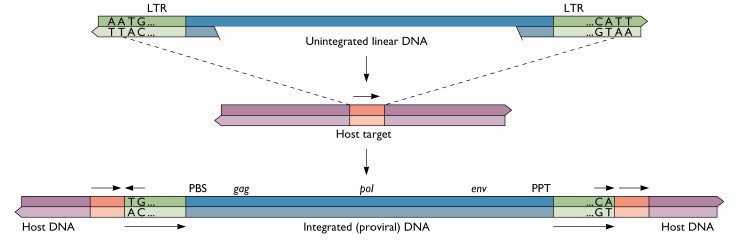
Retroviruses such as XMVR and HIV-1 have genomes composed of single-stranded RNA. This nucleic acid is converted to a DNA copy in infected cells by the viral enzyme reverse transcriptase. The double-stranded viral DNA is then integrated into the chromosomal DNA of the host cell, a process accomplished by an viral enzyme called integrase (illustrated).
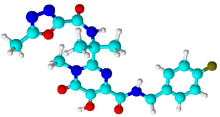
Raltegravir (pictured above left) is an inhibitor of HIV-1 integrase that was approved for use in humans in 2007. The drug blocks the integration of viral DNA into the host genome and therefore inhibits viral replication.
The mouse retrovirus murine leukemia virus (MLV) has been linked to the development of spontaneous autoimmune disease. The mechanism by which the virus induces this disease is not known, but stimulation of innate immune responses by viral DNA might be involved.
Raltegravir also inhibits integration of MLV DNA into the murine genome. When mice with autoimmune disease were treated with raltegravir, they succumbed to autoimmune disease a month earlier than untreated animals. Mice without the disease were not affected by the antiviral drug. The authors speculate that by inhibiting viral DNA integration, raltegravir increases the amount of unintegrated viral DNA, elevating innate responses and exacerbating autoimmunity.
It’s not known if raltegravir is active against XMRV, the retrovirus associated with chronic fatigue syndrome. Given the similarity between the genomes of MLV and XMRV it seems likely that the drug will inhibit the virus. If the ability of raltegravir to treat CFS is tested in clinical trials, it will be important to carefully monitor treated patients for signs of autoimmunity. CFS has an autoimmune component which could worsen with raltegrivir treatment.
An obvious question is whether raltegrivir induces autoimmunity in AIDS patients. I’m not aware of any such reports, which is probably not surprising given the fact that HIV-1 infection leads to immunosuppression.
CFS sufferers should not despair: other antiretroviral drugs, including chain terminators such as AZT, do not allow the accumulation of unintegrated viral DNA. These compounds might be useful for treating the disease.
G.B. Beck-Engeser, D. Eilat, T. Harrer, H.-M. Jack, M. Wabl (2009). Early onset of autoimmune disease by the retroviral integrase inhibitor raltegravir Proceedings of the National Academy of Sciences : 10.1073/pnas.0908074106
The accumulation of unintegrated viral DNA might actually be a good thing – infected cells will undergo apoptosis, clearing the blood of infected lymphocytes, and new healthy lymphocytes will be created out of marrow stem cells.
Pingback: Tweets that mention Raltegravir inhibits murine leukemia virus: implications for chronic fatigue syndrome? -- Topsy.com
Very interesting finding.
Vincent. Would you think that XMRV could develop resistans to for example AZT if used in single drug regimen in a similar way like HIV does?
Although it is a little soon to start treating CFS patients for a virus that may not be causing any sickness, you raise some interesting points. CFS patients have markers of chronic immune activation, and thus rapidly dividing cells. Since XMRV is a gamma retrovirus it needs rapidly diving cells to infect. It is not clear whether infection with this virus is a passenger of this condition (tired immune system with rapidly diving cells), or the causative agent of the disease and chronic activation.
Nonetheless, treatment with HIV antivirals will be really interesting. The published XMRV sequences show a very high degree of conservation. This may indicate the viral genome is less plastic than HIV’s, meaning that it may not be able to tolerate mutations as well as HIV. In line with the apparent low mutation rate is the fact that the viral loads in patents are not very high (compared to HIV). The low genetic diversity combined with low viral loads means that the chances of having drug resistant viruses already present in a patient are much lower than that of HIV, improving chances of a successful outcome of treatment. In the case of this retrovirus Darwin may be on our side.
Undoubtedly XMRV would quickly become AZT resistant as does HIV in
monotherapy. Multiple anti-XMRV drugs are needed.
You might need to bring in some HIV-clinical experts on this one or something.
The one thing I've seen mentioned several times in regards to anti-retrovirals(ARV) and HIV/XMRV is that a lot of ARV's for HIV inhibit replication. However XMRV is thought to replicate much much less than HIV. For instance John Coffin at the October Chronic Fatigue Syndrome Advisory Committee(CFSAC) meeting said something to the effect of the total difference between XMRV types that were reported in possibly Dr. Peterson's presentation at the same meeting showed less variation than HIV shows within a few weeks in a person's body. What this means is that XMRV doesn't replicate very often while HIV replicates like mad. Therefore ARV's aimed at inhibiting replication will not likely have much effect on XMRV, but rather reverse trascriptase inhibitors would be more the way to go. There- I've basically exhausted my knowledge of the subject in one paragraph. The one other thing I've heard is that Nancy Klimas was reported in a newspaper article to be testing reverse transcriptase inhibitors in eight patients, I don't know if this is new or old news.
So basically we need an AIDS expert or retrovirologist or something to write a blog breaking down the different classes of ARV's and stating the potential pro's and con's of each.
That's pretty interesting about autoimmune problems, I also have Hashimoto's thyroiditis in addition to what I suspect is XMRV and tried taking some herb, chanca piedra, which was reported to inhibit MLV's, and it made me feel pretty bad. Maybe that's why.
If it is true that XMRV replicates to far lower levels in patients
than HIV-1 (and the data on this issue are scarce right now) then it
could be that drug resistance will arise more slowly. The vast
majority of anti-HIV drugs are reverse transcriptase inhibitors that
block viral replication. There are the nucleoside and non-nucleoside
RT inhibitors (NNRTIs); whether the latter would inhibit XMRV is not
known. Then we have the protease inhibitors which are tailored to the
HIV-1 protease and might not inhibit XMRV; the integrase inhibitors;
and fusion inhibitors. The statement that ARVs that block viral
replication will not have much effect on XMRV doesn't make sense to
me. Blocking viral replication is what antivirals is all about. All
HIV ARVs with the exception of the integrase inhibitors will block
viral replication and not lead to accumulation of circular DNAs.
Fusion inhibitors are specifically tailored to block the binding of gp120 to CD4 and it's co-receptor, while XMRV relies on the XPR1 and SYG1 proteins for entry. XPR1 is a G-protein coupled receptor, whose function is not yet completely understood, while SYG1 (also a G-protein coupled receptor) is a neuronal receptor that directs nerve cells to connect with each other (Ouch!). Protease inhibitors against HIV have only weak activity against other retroviruses. Even though the catalytic site is relatively similar (they are aspartic proteases with relatively conserved active sites), the flaps of the enzyme are different enough not to allow HIV protease inhibitors to enter the binding pocket. One prime XMRV research goal will be to determine the crystal structure of XMRV protease.
All this talk about XMRV makes me go crazy. I have ME/CFS and when they link it to HIV and AIDS it really scares me. Is this virus as bad as HIV, and the question I'm asking myself all the time is, am I going to die from this?? Do I even have a future?
No XMRV is not as bad as HIV. ME/CFS is not a new condition so we know that its not compareble to HIV/AIDS. Also with good antiviral treatment HIV -positive people could live a healthy long life.
I'm no virologist, but here's my take.
Comparisons with HIV seem to me to be largely based on simply both being retroviruses, both causing immune dysfunction, so forth — similarities, certainly, but there are also important differences.
There's really no easy scale of “badness”. Certainly ME/CFS hasn't led to anywhere near the level of death that we saw from AIDS in the years before decent treatments for HIV, so I wouldn't personally say there's anything at all to suggest that untreated XMRV –> CFS–> death in anywhere even vaguely approaching the same proportion. I lived in the bay area when AIDS was unfolding, I remember it well, and no, we're not anywhere like that with this disease.
At the same time, if XMRV really is causative in ME/CFS, it's certainly associated with a high degree of disability in some folks. That's bad, too, even if it's not fatal, and I tend to think that trying to say “as bad” or “not as bad”, when you're talking about disabling illnesses, turns quickly into a weird and kind of meaningless pursuit.
I'd guess that it's theoretically pretty likely that people with XMRV will be more susceptible to various cancers. But saying that for sure will require a lot more research, and I'm sure the more virologist-types know a lot more about that than I do.
And honestly, I don't mean this to sound trite or whatever, but we all have a future until suddenly we don't anymore. Even if you did have a fatal disease, there's every reason to go on living as long as you can, which may wind up being as long as you might have anyway. Not that there's any way to know that anyhow, of course.
One of the hard things I've seen in HIV+ friends from time to time is that they sometimes feel, as soon as they're diagnosed, that they're on death's door. Really, most now live on for a long time with proper treatment. That winds up requiring another readjustment when they've been doing pretty well on medication for a while and realize they have no idea what they want to do with themselves, since they'd kind of given up on the whole “future” concept.
according to dr. klimas, single drug therapy might be possible with XMRV because of its supposed low mutation rate….but this still needs confirmation. the in vitro studies will be completed in 2-3 months. i plan to start low dose AZT as soon as possible because i am bedbound and in constant agony after 17 yrs of CFS. i am hoping AZT might help and resistance will not develop until a new drug is marketed.
Hi, Thanks for writing about XMRV in CFS. I am a physician with CFS. I was not aware there were viral load tests for XMRV – are these research-lab based or are there any commercial tests available? Also, what is your source for saying the XMRV viral load of CFS patients are low? I had not heard of this. Thanks.
me again. just got work that low dose AZT is a bad idea cuz of resistance developing. i am sure i was previously told that resistance would probably not develop with XMRV…so now i am back to square 1.
There has been a lot of talk in the scientific community this week about XMRV is Cleveland, and I spoke to a colleague that was in attendance. A considerable amount of talk centered around compounds to target XMRV – Isentress was one of the big ones, in addition to other integrase inhibitors. The only concern I have about AZT is the side effects – finding a doctor that will prescribe it, and monitor your bloodwork. You will also have to pay out-of-pocket, as provincial drug plans will not cover it. AZT has the advantage in terms of cost – about the cost of a large cup of coffee. Isentress will cost far more -$16 a day, but has very few side effects, and will bring viral load down faster. It might not be long before the natural health food stores start carrying chicoric acid – a natural integrase inhibitor from Echinacea, the only downside is that it cannot enter cells as readily as Isentress. There is a small risk that Isentress could cause autoimmunity in humans like it did with mice in the form of a lupus like illness, but this was only observed in mice with a certain genetic succeptibility.
Dr. Luckett:
Â
Thank you so much for your email. I am in constant agony with CFS and really appreciate any information.
Â
May I ask why AZT would not be covered by provincial insurance plans?
Â
I wonder if I might be able to obtain HIV drugs (such as Isentress) with a doctors prescription even if I do not have HIV.
Â
Thank you,
Sue
Can you comment on what you think the utility of something like Bavituximab might be in treated a virus such as XMRV? Bavituximab is in trials now against HIV by Duke and HepC/HIV by the manufacturer. It seems rather promising as an antiviral/immune modulator agent for use with lipid enveloped viruses, but as a layperson I am not sure I understand it. It is described as an “anti-ps” agent.
http://www.peregrineinc.com/index.php?option=co…
http://www.vipdx.com/ WPI posted a link to a small lab they gave permission and assistance to in order to process blood for XMRV. It's valid. Lombardi is part of the set up. The link will explain more. A doctor must sign in order to get the vials and directions, then you send it back in overnight. It's private and $400 for live, $650 for both live and antibodies. There is a waiting list of 4-6 weeks last I heard.
Kristin – No one ever died with AIDS ever died directly from the infection – they died because of associated diseases and infections such as cancer. There are a small but growing group of studies linking viral cancers and CFS, but the CDC refuses to track these deaths, which by the way is part of their job. The result is that we don't know how prevalent associated diseases are in CFS.
As for a future, until you are dead there is always a future. Live, love, laugh for life is always short no matter what the circumstances are.
The first part of Patrick's remark is incorrect. Many of the biomedical clinicians who have seen thousands of CFS patients over the past decades have been stating since the late 80s that patients are as sick as HIV patients (before AZT and friends), patients with end stage renal disease and patients with COPD. This is a horrible and crippling disease.
In a NYT column CFS immunologist and expert Dr. Nancy G. KIimas made the following reply to a similar comment: “…But I hope you are not saying that C.F.S. patients are not as ill as H.I.V. patients. My H.I.V. patients for the most part are hale and hearty thanks to three decades of intense and excellent research and billions of dollars invested. Many of my C.F.S. patients, on the other hand, are terribly ill and unable to work or participate in the care of their families.
I split my clinical time between the two illnesses, and I can tell you if I had to choose between the two illnesses (in 2009) I would rather have H.I.V. But C.F.S., which impacts a million people in the United States alone, has had a small fraction of the research dollars directed towards it…”
Maija………….i do think same as you……if they are not curative…..better not take them as they are even more toxic and expensive….
Bavituximab is an antibody directed against a phospholipid which is
normally on the interior of the cell. In cells infected with certain
viruses the phospholipid appears on the cell surface and also on
enveloped virions. It's been shown that the antibody can inhibit
multiplication of a wide variety of enveloped viruses, and it's
currently in safety trials in humans. As far as I know it hasn't been
tested against XMVR in vitro but that is likely in progress. If it has
in vitro activity then it should be tested for utility in CFS. It
seems promising but it is too early in the clinical trials to know
whether it will be effective.
i have had CFS since 1990 i take a lot of magnesium per dr teitelbaum and vit c, b,d and eat as many organic veggies, fruits as i can i have found vitamin therapy to be very helpful vit d especially as i also suffer from SAD
CFS can be a very depressing disease i also avoid cold and places where people are i try to get as much sunshine as i can the CFS is worst during the winter months and when it rains i have to avoid getting chilled or wet as my immune system is so sensitive
i also have a very good chiropractor as my CFS appeared in 1990 after a severe neck and back injury
this year i have been better i credit vit d a lot for my increased energy
i use capazin ceme for the jjoint pain of CFS it is totally organic it can be purchased at sorenomoreusa.com made in new mexico is is composed of grapefruit rind, aloe vera and the seeds from the california pepper tree
cost is 15 dollars a jar it has a warming effect and helps me sleep the big problemwith CFS is getting curative sleep the magnesium calcium zinc combination helps me with that
the magnesium helps the mitrochrondria produce energy it calms the muscle spasms and is a natural relaxer the zinc is for the immune system and the calcium helps sleepand helps relaxation etc
Hi, Heidi,
I'm the prior guest. Thanks for the info but VIPdx test are not verified yet – no sensitivity/ specificity characteristics (I asked them for this info) and do not measure viral load. The tests are not antibodies – it's for co-culture and PCR/DNA.
Hi, Heidi,
I'm the prior guest. Thanks for the info but VIPdx test are not verified yet – no sensitivity/ specificity characteristics (I asked them for this info) and do not measure viral load. The tests are not antibodies – it's for co-culture and PCR/DNA.
Pingback: Inhibitors of XMRV