
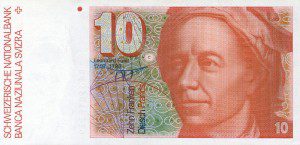
 Influenza virus may be transmitted among humans in three ways: by direct contact with infected individuals; by contact with contaminated objects (called fomites, such as toys, doorknobs); and by inhalation of virus-laden aerosols. The contribution of each mode to overall transmission of influenza is not known. But something that most of us touch on a daily basis – paper currency – appears to be able to hold infectious virus for a surprisingly long period of time.
The idea that currency can serve as a vector for transmission of influenza virus is attractive since billions of banknotes change hands daily throughout the globe. To determine if virus can remain infectious on banknotes, a small volume (50 microliters) of a viral suspension was added to a 50 franc Swiss note. The note was kept at room temperature, and at different times the inoculated area was cut out, immersed in buffer, and viral infectivity was determined in cell culture. Infectivity of influenza A (H1N1) and influenza B viruses was detected for only 1 and 2 hours, respectively. In contrast, two different influenza A (H3N2) viruses were detected up to 1 and 3 days.
As expected, the more virus placed on the banknote, the longer infectivity could be detected. Addition of respiratory secretions to the viral inoculum also increased the ‘survival’ time. For example, influenza A/Moscow/10/99 (H3N2) remained infectious on banknotes up to 8 days in the presence of mucus, compared with 2 days without mucus. When higher amounts of virus with mucus were added to banknotes, infectivity could be detected for 17 days. Mucus might provide a protective matrix which slows the loss of viral infectivity.
To determine if similar results would be observed using human specimens, nasopharyngeal secretions from children with influenza-like illness were inoculated onto banknotes. Virus from half of the samples could be detected on the currency for 24 hours, and from 36% of specimens for 48 hours.
These observations demonstrate that influenza virus infectivity remains on banknotes for days. In theory virus could be transferred from currency to the nasal tract by contaminated fingers, initiating an infection. Whether humans acquire influenza by this route is unknown. However, good hand hygiene, which is known to remove influenza virus, is an excellent preventative measure – especially after handling currency.
This study was carried out – where else? – in Switzerland, where 7 million individuals exchange 20 – 100 million banknotes each day.
Thomas Y, Vogel G, Wunderli W, Suter P, Witschi M, Koch D, Tapparel C, & Kaiser L (2008). Survival of influenza virus on banknotes. Applied and environmental microbiology, 74 (10), 3002-7 PMID: 18359825
Pingback: Tweets that mention Influenza virus is infectious for days on banknotes -- Topsy.com
Pingback: uberVU - social comments
This research is of course worth repeating as it is relevant to the current pandemic. For those who are interested, it was presented at the flu congress in Toronto in 2007, and reported by New Scientist. http://www.newscientist.com/article/dn12116
We don't just write about recently published research here – we often
go back into the literature to explain what has been done before. Just
because it's old, doesn't mean it's no longer interesting. Or worth
repeating.
Indeed, I specifically said it was worth repeating. I merely posted the source, for those interested – for example, someone looking for the journal reference.
ahh, I lost my edited post.
works only when I register _before_ editing
it should be possible to actually test, whether flu spreads by banknotes.
Why is there no positive report ?
34 comments 0 likes 1 point
but I can see only 5 comments
You are suggesting that we examine actual banknotes in circulation for
the presence of virus? I agree it's a good idea. I can't say why it
hasn't been done yet.
Yes, it's a problem with disqus comment system.
create viruses with some characteristic synonymous mutations and put them on banknotes,
then see whether they spread, whether these mutations are collected somewhere
is it ethical ?
It's not ethical to release viruses on banknotes as you suggest. You
could do that type of experiment only in a confined study with
volunteers, for example put people in a room, give them contaminated
notes, and see if they acquire influenza.
so, when I have flu and sneeze (deliberately) on a banknote (or coin ?) and then spend it,
they should punish me ?
I'm referring to the ethics of conducting a government grant-sponsored
clinical trial. There are strict rules for such trials and one
includes not releasing microorganisms into the environment where they
might infect unsuspecting individuals. All participants in clinical
trials in which biologics are administered must give informed consent.
If you deliberately spread an infectious disease to another person
without telling them, you could be liable. There are examples of
people spreading HIV to others and being prosecuted for doing so. In
the case of influenza prosecution would be difficult unless death or
disability resulted.
so, will you make a forum, please ?
it may be different in other countries…
sneezing on hated dollar notes could be considered a good thing
in some groups
use banknotes to deliver dead-viruses or vaccine or somehow disabled/attenuated viruses.
or to spread a counter pandemic with a less virulent strain to induce immunity
against the bad virus (H5N1)
create a flu-virus of especially low virulence and spread it by banknotes
when a pandemic threatens. Or even a rhinovirus – there were 2 recent reports
(France,Sweden) that rhino probably/maybe delays flu-waves.
It should be easy to spray/infect/disinfect banknotes automatically in the banks,
supermarkets, with the antiviruses against the currently circulating strains
there should be differences between the banknotes (and coins)
of different countries. Test the survival on banknotes of some
countries and correlate with the amount of flu,RSV,…
Yes, I will make a forum for virology blog, within a week or two,
doing a lot of teaching now.
Like the blog good info.
Like the blog good info.