
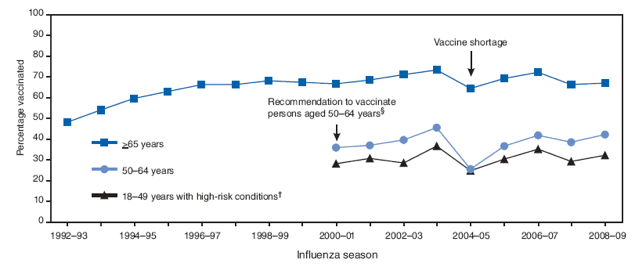
 All the evidence I’ve seen so far points to a poor uptake of the influenza 2009 H1N1 vaccine in the United States. This is not good news – inadequate immunization means more infections and more deaths.
A few weeks ago I asked a class of about 50 students in a course on Emerging Infections whether they would receive the 2009 influenza H1N1 vaccine. None of them raised their hands. Yesterday, I taught seven high school biology classes about viruses; I asked each group (about 30 students) if they were going to get immunized. About 5 out of over 200 students said they would.
My informal poll may not be indicative of the mood of the entire nation, but there is no doubt that the vaccine is in trouble. You would have to be living in a cave to realize that fear about the 2009 H1N1 vaccine is being propagated by the press and various blogs and websites. Incorrect information from people who know little about viruses, viral vaccines, or infectious disease is easy to find. The following email from a Microbiology Professor in Portugal illustrates the problem:
It is impressive the amount of hate emails on H1N1 vaccines. With all this hate email, people are starting to ask if they should take the vaccines or not. I just hope it doesn’t spread to other vaccines. I’ve heard from a few health related workers that they won’t take the vaccines because they have doubts about their safety. The worst thing is, that most of the times the reason for that, is just an email they have recieved.
As you can see from the image above, even in non-pandemic years, the number of people who receive influenza vaccine in the US is low. The CDC estimated that the overall rate in the 2008-09 season was 32.6%. The number varies according to age and ethnicity, but the best immunization rate – 67% – is in those over 65 years of age. When the vaccine is a good match with the circulating strain – which happens to be the case with the 2009 H1N1 strain – the vaccine is 70-80% efficacious. But it’s not helpful at all if only a third of the general population is immunized.
I’ve already received my seasonal influenza vaccine and I’m waiting for the 2009 H1N1 vaccine to become available. My entire family – including my three children – will receive both vaccines. Is there any better endorsement for the vaccine? If you don’t believe me, read Paul Offit’s words on why the vaccine is safe and efficacious.
Please let me know whether or not you are going to receive the 2009 H1N1 vaccine – and your reasons for shunning it – by posting a comment.
Centers for Disease Control and Prevention (CDC) (2009). Influenza vaccination coverage among children and adults – United States, 2008-09 influenza season. MMWR. Morbidity and mortality weekly report, 58 (39), 1091-5 PMID: 19816396
It's highly unlikely you had H1N1 if you only had a headache and stomachache but no respiratory symptoms. Sounds more like viral gastroenteritis. In the absence of a positive H1N1 diagnosis (confirmed either by a lab test or rapid nasal swab test) you should not assume you had H1N1. The CDC recommends that people get the vaccine if they experienced some type of illness but did not have a proven case of H1N1. It will not harm you to have it even if you did have H1N1, which seems unlikely based on your symptoms.
There is no scientific evidence that homeopathy works as anything but a placebo. There is no harm in trying it for minor ailments if one is so inclined but it would be extremely unwise to rely on it to protect you from a potentially life-threatening illness.
Had the vaccine two weeks ago (I have asthma and a heart problem) and had no reaction other than a sore and bruised arm because the nurse jabbed the needle into my arm with all the vigor of a spear fisherman. My college-aged son (has asthma and other health issues) had a nurse with a lighter hand and had no reaction at all, other than relief that I would finally quit bugging him to stay out of crowds and use hand sanitizer at 5 minute intervals. My husband works in an office where people insist on coming to work sick even though there was a confirmed case of H1N1 that started the chain of illnesses. He has had to resort to wearing a mask at his desk to protect himself from these people. He gets teased relentlessly but so far he has remained well while the others have fallen. He would love to get the vaccine but he is at the bottom of the priority groups and it may be a month or more before it arrives in our area. It'll be a miracle if he escapes it because of the thoughtless people he works with, but we can always hope.
See my recent post re Novartis vaccine. Half dose seems to be
protective. At worst it will lead to infection but milder disease.
I got really sick too 4 days later. Fever, sore throat, and sore muscles everywhere. Had to take a week off work. I was just trying to do the responsible thing and ended up missing a week's work because we are not allowed to go to work with a fever.
Just wondering about reactions to the H1N1 vaccine. My daughter had the vaccine over 2 wks ago -sore arm as expected but no other side effects . I received it the following week with just mild sensation at the injection site.
My husband was able to get the vaccine a few days ago. He went with 2 other work mates and by the next day all of them felt as if they had “the flu”….no fever but all the other classic symptoms.
Are symptoms from the vaccine any indication about a persons immune response?
Is there any medical evidence to back up suggestions that people that feel like they have “the flu” after a vaccination are better protected against-in this case- H1N1 virus?
I am more inclined to think it was perhaps the batch of vaccine as they were all vaccinated at the same time or some other effect.
A mom
I believe the CDC would like all side effects reported so they can evaluate the information. You can report and do searches here. Citizens can make their own reports if health care providers are unwilling.
http://vaers.hhs.gov/index
I received the swine-origin H1N1 shot a month ago with absolutely no ill effects. Two weeks ago, my healthy 23 year old daughter received the nasal spray for this vaccine and had a bit of a headache, sneezing, and a mild sore throat for about 3 days. The sore throat on day 4 progressed to a very swollen throat and a low-grade temperature. One week after the vaccine, she was given both a strep culture and a mononucleosis blood test, both of which came back negative. Two weeks later, her temperature is normal, she feels a bit better, but her throat still feels a little swollen. In all of this time, only the nurse at her doctor's office has seen her and not her doctor, and since her tests were negative, she was merely told to take Tylenol and rest. Two weeks later, I am wondering if her symptoms have been caused by the nasal spray vaccine, especially since it contains a live virus. I am encouraging her to be seen by her doctor on Monday (today is Saturday). I don't ignore coincidences, and it seems suspicious to me. Has anyone else had similar reactions to the swine-origin H1N1 nasal spray vaccine? Would you be inclined to suspect the vaccine in this case Prof. Racianello? I know you are not a medical doctor, but rather a virologist and scientific researcher, but your opinion would interest me.
Follow-up to above post on nasal spray vaccine:
Well, finally, after two weeks, my 23-yr old daughter, who received the swine-origin H1N1 nasal spray vaccine and consequently had a bit of a headache and tonsillitis, is perfectly well again.
Perhaps the vaccine had something to do with her tonsillitis, but more likely I suppose, she coincidently had another virus lurking around which decided to confuse us by striking at that time!
I have not read of any similar reactions, so I'll have to put it down to coincidence.
Still think we'll choose the injection next time if available.
Well my husband got the shot today he is military so it was an order. He is now home sick in bed and has thrown up violently for the past 3 to 4 hours every half hour or so. Any answers?
Dr. Racaniello,
Did you have the H1N1 vaccination?
If not, are you planning to? There doesn't seem to be much talk about this virus in the media anymore. What are your thoughts about another wave of this virus “hitting' the United States and Canada in the coming months???
Dr. Racaniello,
Did you have the H1N1 vaccination?
If not, are you planning to? There doesn't seem to be much talk about this virus in the media anymore. What are your thoughts about another wave of this virus “hitting' the United States and Canada in the coming months???
right tell me straight please,mty nan is frail 87 and thgink flu jab is the law.every time she has it shes  very poorly,i told her two year ago dont have it ,but she has,yet again due to docs,i dont wont her to have it,shes very poorply yet again,ehy dont you just send letters out,to people who are fit and can take the jab my nan cant