
One of the most important procedures in virology is measuring the virus titer – the concentration of viruses in a sample. A widely used approach for determining the quantity of infectious virus is the plaque assay. This technique was first developed to calculate the titers of bacteriophage stocks. Renato Dulbecco modified this procedure in 1952 for use in animal virology, and it has since been used for reliable determination of the titers of many different viruses.
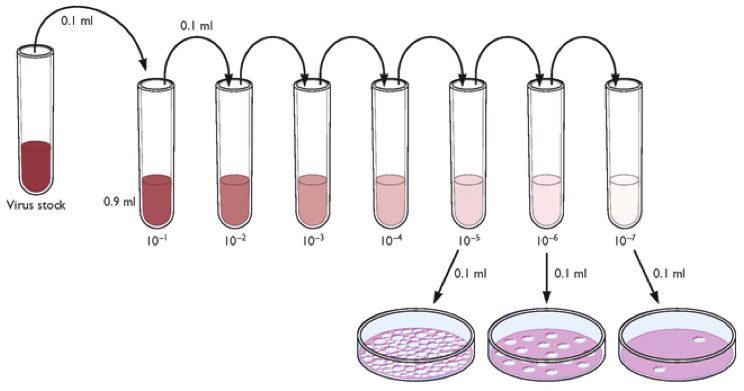
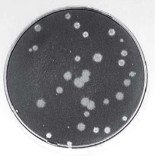 To perform a plaque assay, 10-fold dilutions of a virus stock are prepared, and 0.1 ml aliquots are inoculated onto susceptible cell monolayers. After an incubation period, to allow virus to attach to cells, the monolayers are covered with a nutrient medium containing a substance, usually agar, that causes the formation of a gel. When the plates are incubated, the original infected cells release viral progeny. The spread of the new viruses is restricted to neighboring cells by the gel. Consequently, each infectious particle produces a circular zone of infected cells called a plaque. Eventually the plaque becomes large enough to be visible to the naked eye. Dyes that stain living cells are often used to enhance the contrast between the living cells and the plaques. Only viruses that cause visible damage of cells can be assayed in this way. An example of plaques formed by poliovirus on a monolayer of HeLa cells is shown at left. In this image, the cells have been stained with crystal violet, and the plaques are readily visible where the cells have been destroyed by viral infection.
The titer of a virus stock can be calculated in plaque-forming units (PFU) per milliliter. To determine the virus titer, the plaques are counted. To minimize error, only plates containing between 10 and 100 plaques are counted, depending on the size of the cell culture plate that is used. Statistical principles dictate that when 100 plaques are counted, the sample titer will vary by plus or minus 10%. Each dilution is plated in duplicate to enhance accuracy. In the example shown below, there are 17 plaques on the plate made from the 10-6 dilution. The titer of the virus stock is therefore 1.7 x 10⁸ PFU/ml.
Next we’ll consider how the plaque assay can be used to prepare clonal virus stocks, a step that is essential for studying viral genetics.
Dulbecco, R., & Vogt, M. (1953). Some problems of animal virology as studied by the plaque technique. Cold Spring Harbor Symp. Quant. Biol., 18, 273-279
Pingback: The Plaque Assay | Citizen Science 2017
Dear Sir , we are facing problem with viral plaque assay that always our cell lines die after poring the mixture of agrose .. can i hear recoomendations from you ?
Dear all, I am performing a plaque assay and looking for a recipe for the agarose/agar medium that I can make myself. Due to time constraints it is not feasible to order pre-made in. Any suggestions welcome, thanks.
sir i am doing plaque assay for NDV on cef-df1 cell lines but the 2%agarose i use for overlay has a detrimental effect on my cell line and its dead overnight what can be done to prevent the same