
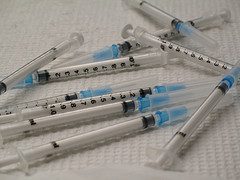
 Health and Human Services (HHS) Secretary Kathleen Sebelius announced on Friday that she is allocating $1 billion in existing funds to purchase large quantities of vaccine against the novel H1N1 influenza strain, and to conduct clinical trials this summer to determine if an adjuvant can be used. If this money is being taken away from research projects, then it’s a very bad idea.
Part of the reason why we were caught by surpsise by the new H1N1 influenza virus is that scientific research in the US was underfunded during the previous administration. As a consequence, many influenza research projects were never carried out that would have helped us to characterize, for example, what types of influenza viruses are circulating in pigs. While I applaud Sebelius’ goal of keeping Americans safe, there is no need to cannibalize research dollars to do so.
It’s certainly a good idea for the government to purchase vaccine in the event that the new H1N1 influenza virus returns to the US in the fall. However, it is not clear to me that the US government should be conducting a clinical trial on an adjuvant. Recently Glaxo announced that it would begin preparation of an influenza vaccine containing a proprietary adjuvant. This adjuvant has not been approved by the FDA for use in the US; presumably the clinical trials announced by Sebelius would test the safety of this vaccine component. It’s not clear to me why an adjuvant needs to be tested, since the current influenza vaccine functions very well without one. I understand that use of the adjuvant will allow each vaccine dose to contain smaller quantities of virus – but it seems to me that another approach would be to boost vaccine production.
Adjuvants are compounds added to vaccines that stimulate the immune response. They work in at least three different ways: they present antigens as particles; they localize antigen to the site of inoculation; and they directly stimulate the intrinsic and innate immune responses. The best known is complete Freund’s adjuvant, a mixture of killed mycobacteria and mineral oil. It is extremely potent but not licensed for use in humans because it causes tissue damage. Three of the active components are muramyl dipeptide, lipid A, and mycobacterial DNA, potent activators of the innate and inflammatory response.
Certain adjuvants, including alum (microparticulate aluminum hydroxide gel) are licensed for use in some human vaccines, such as those against hepatitis A and B viruses. Many others are under development, including Glaxo’s adjuvant, which is proprietary and therefore not revealed. These experimental adjuvants boost the immune response in a variety of ingenious ways. They are promising, but much work remains to be done to demonstrate their safety and effiicacy. That research, including the evaluation of safety and efficacy by clinical trial, is typically done by the manufacturers who will profit from their sale.
I have three messages for HHS. First, why cannibalize research dollars to pay for production of vaccine and testing of an adjuvant? Basic scientific research is just as important for keeping us healthy. Second, if companies will profit from an adjuvant because they will sell more doses of vaccine containing less virus, then they should pay for the clinical trial. Finally, be very careful when deciding whether or not to include an adjuvant in this fall’s vaccine against the new influenza H1N1 strain. We don’t need adverse effects to fuel the anti-vaccine movement.
These are very obvious observations, why weren't they discussed before redirecting money ?
A repeat of the 1918 flu pandemic would have serious national security implications for the United States. At a minimum, trade would take an enormous hit, with extreme collateral damage being done to the rest of the economy, not to mention destabilizing our work force.
If a global pandemic of such an extreme nature does occur. the world is woefully short of vaccine capacity.
In such circumstances, should vaccine only be sold to the highest bidders? What if China offers to pay Roche triple the market price for every does it can produce?
In such national security situations, is it always necessary that key technologies always be in private corporate hands?
What are the national security implications if one or more of these key players becomes bankrupt through foolish moves in the derivatives markets? (Note the recent examples of Porsche, Opel, Volkswagen, etc. in this regard).
Pingback: swine flu faq
Ah.. so it's about security and trade! Now it all makes sense 😉
The start of the Mexican conspiracy….
it's actually very Gheghis esq… cut off trade, when hunger strikes drop dead plague bodies over the walls… nothing new under the sun…
Forgive me if I've missed a major point here, but should they not be focusing on researching on a much bigger threat that is looming round the corner – H5N1? The virulence of H1N1 doesn't justify the vast amount of money that is poured into producing a vaccine for it. Even though there are predictions of more 'waves' of swine flu, judging by the current dynamics of the disease it doesn't seem as threatening to the world as H5N1.
My point is that macro decisions about vaccination policy (and by logical extension adjuvant policy) are substantially decisons about public health.
And in matrices where improved public health is the objective, there are drawbacks to having all the key tools in disparate private hands.
It is false to assume that government sponsored research regimes must necessarily fail. The extended history of DARPA, which has targeted critical defense research resulting in applications ranging from the development of the FTP protocol (and hence the Internet) to Predator drones. convincingly rebuts this urban myth.
Excellent points. Pouring the money for purchasing vaccines are just like wasting the tax payers money. Why federal government should not produce the vaccines with the help of NIH and other state Universities?.
I feel that adjuvant research is also important as it reduce the vaccine dose and increase the duration of immunity.
Finally, I strongly agree that more fund should be allotted for BASIC RESEARCH also
You wrote: “in the event that the new H1N1 influenza virus returns to the US in the fall”
Are you kidding? This pandemic Firstwave hasn't even peaked yet.
New cases may go on all summer; if community circulating, and, travel with no entry quarantines, goes on.
It hasn't left the US yet; it is still ramping up hospitalized cases ( no mater how the CDC tries to “revise” the official definition of a, “hospitalized” case to enron “official” case counts down.)
Communities were supposed to get ready; so, “Early “Targeted Layered Containment could be activated, and would be workable – to reduce infections and deaths, and delay crashing our systems – there was no political will to say so.
The past 5 years have been so full of distortion of Science, and censorhip to the public, it is surreal.
H5N1 Pandemic flu Alert, and ongoing cases/clusters, and Containment operations,
and, the issues on the planning tabs (link hastily re-titled, after pandemic start., to,”Prepare & Respond”)
on pandemicflu.gov -up since Oct. 2005,
and the 2006 State Pandemic flu “summits” with HHS in 2006,
and the, “US State Dept H5N1 factsheet” : strand -for-Pandemic; No food/water/nor medical care at US embassies, policy since July, 2006 (didn't disrupt the Bejing Olympic though- good thing the Alert Phase was unplugged in Jan.2006!), and the April, 2007 DHS,
“Best Practices and Model Protocols” documents unanswered questions for local preparedness,
were not even presidential campaign issues!
Who in future will believe such a, “Big Lie” got pulled off this easily?
See “PFI Pandemic Flu Information Forum” for News (and background)
and forget 'remaining at your desks ' “hoping” for vaccine this calender year;
posters, please see what you can do to be better prepared at home;
feds/state/locals are going to be, “shocked, shocked” and tell you, “sorry” you're “on your own”.
“Fail to prepapre and be tragically wrong” Leavitt said, to state panflu summits, in 2006 – ( then, he retired).
Read what one county's emergency manager and concerned citizens did, given the challenge we all face:
see GetPandemicReady.org
An update on how the $1 billion will be spent, according to Bloomberg: HHS has signed contracts worth $660.5 million with three companies. Novartis will receive $289 million and GlaxoSmithKline will get $181 million to produce the vaccine virus, and an adjuvant. Sanofi-Aventis will receive $190.6 million to produce the virus only. MedImmune and CSL Biotherapies of Melbourne, Australia, will receive $150 million to develop prototype lots of vaccine and to carry out preliminary tests. The rest of the money will be used to purchase more unspecified vaccine ingredients.
Pingback: Adjuvant « Leabright’s Blog
Pingback: Adjuvant effect on H1N1 vaccine
Hello, I just read ur comment regarding use of adjuvant with existing vaccine, I would like to ask one thing , are u more concerned with the side effects cause by the adjuvants or about the funding being utilised by manufacturing comapny and basic researchers dont get the funding?
Dont you feel so that if some new adjuvant is being discovered which is not having any side affect then may be u can apply that adjuvant in many vaccine development? and second thing I want to know is if the virus dosage is reduced by an adjuvant then does that make much of difference on human health or it makes more of the difference to manufacturer(in terms of cost)
I'm the first to be concerned about vaccine side effects, and of
course safety is the primary concern. But money used to study
adjuvants should not come from basic research. There is money for both
activities. In my view adjuvants can extend the vaccine supply so more
individuals can be protected. It's not about manufacturers' profits;
it's about immunizing as many people as possible.
I'm the first to be concerned about vaccine side effects, and of
course safety is the primary concern. But money used to study
adjuvants should not come from basic research. There is money for both
activities. In my view adjuvants can extend the vaccine supply so more
individuals can be protected. It's not about manufacturers' profits;
it's about immunizing as many people as possible.
Diseases such as polio and smallpox, once killed millions, almost non-existent in the United States and Europe and Asia, Thanks for the inoculation.
xanax online overnight shipping
Communities were supposed to get ready; so, “Early “Targeted Layered Containment could be activated, and would be workable – to reduce infections and deaths, and delay crashing our systems – there was no political will to say so.Â