
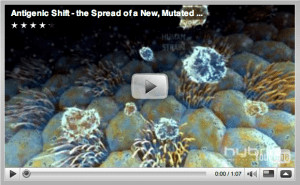
 Recently I asked readers to identify errors in an animation of influenza virus replication. I am impressed with the number of good responses posted in the comments section. Here is a synopsis of the errors (there is more than one).
1. Influenza virus is released from cells by budding, not when the cells burst, as is shown in the animation.
2. Influenza virus is not the only virus capable of antigenic shift.
3. There isn’t any mucus on the epithelium. It should be there.
4. One problem is that the animation describes the production of a mutant virus, but it shows reassortment. The two are not the same. More importantly, the animation illustrates co-infection of cells with a human strain and a swine/avian strain. The implication is that this gave rise to ‘mutated’ viruses which then infected people.
We don’t know how the new virus emerged yet, but here is one scenario. Over ten years ago, pigs that were infected with swine influenza were then infected with avian, and then human influenza viruses. A variety of recombinants emerged which propagated globally in pigs and occasionally infected humans. More recently, swine influenza virus genes from Eurasian and North American pigs mixed. Finally, a human was infected with this pig virus and one virus emerged which was able to transmit. Presumably this virus differs from what was in the pig by a number of base changes which enables the virus to spread among humans.
5. The epithelium is probably incorrect, as pointed out by several readers. It certainly doesn’t look like any respiratory epithelium I’ve seen under a microscope. Some readers had questions about this, but since I’m not an expert on the respiratory epithelium, I’ll refrain from specific criticism.
6. “The current flu in circulation is an entirely new, mutated pathogen…” The virus is not entirely new – it is very similar to what has been circulating in pigs for many years. What is new is the combination of influenza RNA sequences from Eurasian and North American pigs.
The rest of the statement – “formed from elements from human, pig, and avian virus strains” – implies that this combination occurred recently, as does the animation (#4). But this combination occurred over 10 years ago and since then the virus has been circulating in pigs.
7. The last sentence – “Overflowing with mutated viruses, the pig’s respiratory epithelial host cells eventually burst open and circulate the new flu virus into the susceptible human population”. The implication is that reassortment has lead to the production of many ‘mutated’ viruses. Incorrect, as discussed in #4. But it’s true that virus replication always leads to the production of a collection of mutant viruses – or more accurately, viral variants. A human was infected with such a collection of influenza virus mutants; one mutant replicated and transmitted and this is the virus we are seeing today. If this doesn’t make much sense, be patient until we discuss the quasispecies concept.
Perhaps one reader best summarized this animation:
“Nothing useful there….More mis-information…Was there anything remotely accurate?”
If you are wondering why I even bothered to direct you to this video, the answer is that understanding errors is always a learning experience. In my virology class we often discuss ‘flawed’ research papers for this reason.
Movie-makers often get their science wrong, especially when dealing with viruses. The movie Resident Evil and its sequels is an example. But animations produced for educational purposes should be much better than this. Here is a good animation of dengue virus entry into cells:
Have you seen this from Reuters yesterday? What do you think?
Meat from pigs infected with H1N1 flu should not be eaten by humans, a WHO official said on Wednesday, while stressing that existing checks were sufficient to safeguard the food supply from the new virus strain.
Jorgen Schlundt, director of the World Health Organisation's Department of Food Safety, Zoonoses and Foodborne Diseases, said care must be taken to ensure that pigs and their meat were checked for all diseases, including the H1N1 virus that may be present in the blood of infected animals.
“Meat from sick pigs or pigs found dead should not be processed or used for human consumption under any circumstances,” he told Reuters.
It is possible for flu viruses such as the new H1N1 strain to survive the freezing process and be present in thawed meat, as well as in blood, the expert said. But he stressed that there was no risk of infection from eating or handling pork so long as normal precautions were adhered to.
“While it is possible for influenza viruses to survive the freezing process and be present on thawed meat, there are no data available on the survival of Influenza A/H1N1 on meat nor any data on the infectious dose for people,” he wrote in an email reply to questions from Reuters about risks from the respiratory secretions and blood of infected pigs.
Schlundt said it was still unclear whether and how long the virus, which is commonly known as swine flu but also contains human and avian flu pieces, would be present in the blood and meat-juices of animals which contracted it.
“The likelihood of influenza viruses to be in the blood of an infected animal depends on the specific virus. Blood (and meat-juice) from influenza H1N1-infected pigs may potentially contain virus, but at present, this has not been established,” he said.
The WHO has urged veterinarians, farm hands and slaughterhouse workers to exercise caution in their contact with pigs to avoid contamination until more is known about how it manifests in the animals.
“In general, we recommend that persons involved in activities where they could come in contact with large amounts of blood and secretions, such as those slaughtering/eviscerating pigs, wear appropriate protective equipment,” Schlundt said.
The Food and Agriculture Organisation (FAO) and World Organisation for Animal Health (OIE) have said import bans on pigs and pork are not required to safeguard public health because the disease is not food-borne and does not pose a threat in dead animal tissue.
[re: comment above]: I thought that the WHO had moved past fear mongering.
[re: Swine Flu]: It seems a lot of people are using the term “Swine Flu” with a very fuzzy definition. I think the officials erred early on by using this term to tag the new HUMAN flu strain that was, in fact, spreading by human-to-human transmission (and, therefore, no longer a swine flu!). Now, that cat is out of the box! Same with news interview stuff about a combination of swine, avian, and human genes: That created a Crichtonesque public fear response.
About 2 weeks ago, I coined a new term for the virus — Swimanavian Flu. I like that much better! Just thought I would share…
Dr. Racaniello,
Interesting stuff – as always!
I just had another thought after reading that phrase above about antigenic shift… If influenza is one of the primary examples commonly listed, then surely HIV must be considered capable of that as well?. I've even heard that its mutation rate is fast as well. How would that HIV mutation rate compared to influenza?
Another thought, perhaps a side question: If an HIV virus can invade a cell, I assume it can invade macrophages? Could HIV infect a macrophase, and amongst mutatations develop the ability to infect lung macrophages… which could result in it becoming a respiratory disease?
I wonder sometimes though if bacteria could be strong enemy that many people thought was licked…but now it seems immunology seems to be back in style. It seems bacteria are quickly developing resistance against our broad-spectrum drugs, plus their ability to scrounge DNA lying around seems to work to their benefit.
Regards,
Bill McCulley
Lewisville, TX
Thanks Dr. Racaniello for your gifted efforts to educate non-virologists about a challenging subject that has the general public's interest right now. Also I appreciate that you are monitoring the new H1N1 outbreak and sharing your observations with us.
If you or any other virologist could help me out with something I am struggling to understand, I'd very much appreciate it.
I noticed that a new vaccine was trialed in rural central Mexican pigs not long ago.
http://www.ncbi.nlm.nih.gov/pubmed/18440675?ord…
I'm in no way saying there is a connection, and as far as I know, no pigs have been found to be infected with this new virus in Mexico. But I did get curious about whether vaccine phages could exchange genetic material with natural viruses in hosts. It looks like there is some general possibility, even for inactivated phages to do so, (if they are reactivated).
http://www.pubmedcentral.nih.gov/picrender.fcgi…
Can anyone rule out that possibility in this case? Thanks!
Bill,
Dr. Racaniello has already indicated that he intends to blog on the topic of quasispecies. Hopefully, this future blog will help to clear up your question. But, to focus your interest, all single strand RNA viruses (that includes HIV) suffer/enjoy the consequences of unfaithful replication of the their genomes. The error rate for their polymerases has been estimated to be as high as 1 in 10,000 bases. For most RNA viruses, that means approximately one mistake per genome transcription/replication. Most mistakes are inconsequential or lethal and, therefore, do not affect virus evolution. For others, it is “survival of the fittest” at its best!
I don't know how someone would know that a sick or dead pig had
influenza. But it seems common sense that one shouldn't eat the meat
of a dead or sick pig. On the other hand, just as a live pig may
transmit influenza to a human handler, so might a dead pig, as long as
the virus is still present. Influena virus can last for several days
on surfaces, even without freezing.
I believe I've answered your question about HIV mutations in a recent
post at virology blog. As for whether HIV can infect
macrophages…yes, there are some strains that can infect these cell
types. This isn't sufficient to make the virus into a 'respiratory
pathogen' – it would have to replicate in the respiratory tract.
Viruses can in theory evolve to do anything, but there are constraints
that limit what actually occurs. For example, the changes HIV might
have to undergo to replicate in respiratory tissue might not allow the
virus to replicate.
The viruses that you mention in the study below are bacteriophages,
which infect bacteria and not any other host. They are being examined
for their ability to eliminate bacterial infections. Phages can and do
exchange genetic material in the 'wild' and there is no reason to
believe why such a 'vaccine' phage would not be able to do so.
Thanks for clarifying that for me, Dr. Racaniello!
Thanks for clarifying that for me, Dr. Racaniello!