
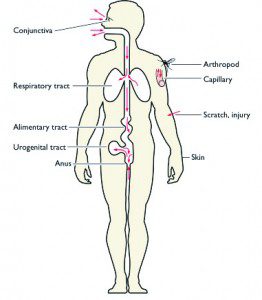
 In a recent press conference (transcript pdf), Dr. Keiji Fukuda of WHO made the following statement about infection with the new influenza H1N1 strains:
The illness that we are seeing is generally consisting with seasonal influenza infection. That is the kind of symptoms that the milder cases are experiencing and generally what are seen with other influenza viruses, although there is some suggestion that perhaps cases are developing diarrhea more often than is normal with seasonal influenza influenza or seen with seasonal influenza.
But human influenza is a respiratory disease – how can it cause gastrointestinal symptoms?
According to the textbook Clinical Virology (ASM Press), in infants and children,
About 40% of symptomatic patients have fever, cough, and rhinitis, up to 40% have emesis or diarrhea, and 25% or more have otitis media or lower respiratory tract disease.
Furthermore, CDC notes that
Influenza is a respiratory illness. Symptoms of flu include fever, headache, extreme tiredness, dry cough, sore throat, runny or stuffy nose, and muscle aches. Children can have additional gastrointestinal symptoms, such as nausea, vomiting, and diarrhea, but these symptoms are uncommon in adults. Although the term “stomach flu” is sometimes used to describe vomiting, nausea, or diarrhea, these illnesses are caused by certain other viruses, bacteria, or possibly parasites, and are rarely related to influenza.
Why would influenza virus infection cause gastrointestinal symptoms? In humans, there is no evidence that the virus replicates in the intestine. Some avian H5N1 subtypes appear to be able to multiply outside the respiratory tract in humans, but such infections are rare. In wild birds, influenza viruses replicate extensively in the intestine and are shed in feces. The reasons for the difference in the location of virus replication in humans and birds are not understood.
I can think of at least two reasons why influenza might be accompanied by gastrointestinal symptoms: concurrent microbial infections, or cytokines such as tumor necrosis factor-alpha that are induced by influenza virus replication in the respiratory tract. Neither involves multiplication of influenza virus in the alimentary tract.
de Jong, M., Simmons, C., Thanh, T., Hien, V., Smith, G., Chau, T., Hoang, D., Van Vinh Chau, N., Khanh, T., Dong, V., Qui, P., Van Cam, B., Ha, D., Guan, Y., Peiris, J., Chinh, N., Hien, T., & Farrar, J. (2006). Fatal outcome of human influenza A (H5N1) is associated with high viral load and hypercytokinemia Nature Medicine, 12 (10), 1203-1207 DOI: 10.1038/nm1477
Gu, J., Xie, Z., Gao, Z., Liu, J., Korteweg, C., Ye, J., Lau, L., Lu, J., Gao, Z., & Zhang, B. (2007). H5N1 infection of the respiratory tract and beyond: a molecular pathology study The Lancet, 370 (9593), 1137-1145 DOI: 10.1016/S0140-6736(07)61515-3
Love your blog. Thank you for providing more indepth information. I have a couple of questions that I have not been able to find answers to. What, if any, is the risk of this visus transmitting via food. I know they are saying there is none but certain things don't add up. If this is a swine, bird, human virus combo, and if avain virus is transmissable via poultry and eggs, isn't there a chance that this “novel” strain is as well? Also, what if foods aren't properly cooked? And, there seems to be some conflicting views on how long these germs last on an inanimate object. How long do they last?
And finally, what would your reccommendation be as far as precautions? I have young children and am concerned that just washing their hands may not be enough.
What an interesting post. For general information, a company has created a special eLearning module to help educate people on the virus. Check it out at: http://dwarfurl.com/0d9ad
Perhaps I'm misunderstanding my own reference, but my understanding was that the HA protein has to be cleaved by a protease enzyme to infect a particular cell, and that the enzymes with the appropriate specificity were found specifically in respiratory epithelium in people.
That is correct, and this is another determinant of tropism. We'll
cover this later – but in humans, the protease that cleaves the HA is
only found in the respiratory tract. In birds, HA of avian strains can
be cleaved by a protease that is produced in all tissues.
Consequently, when avian strains infect humans, they can replicate in
all tissues.
Thanks for spreading the word, I really appreciate it.
Emma
Thanks for spreading the word, I really appreciate it.
Emma
Pingback: A Filipino Infectious Disease Specialist on A(H1N1) Virus | The Learning Blog
Pingback: How To Tell If You Have The Flu And Not Just A Cold, Because The Symptoms Can Be Similar – Bustle – NewsBlog
11 days ago I was diagnosed with the H1N1 influenza. My doctor sent me to ER where I was quarantined and sent home. Symptoms, 4 days with fever of 101+, violent cough and fatigue. I have had a history of asthma triggered by bronchitis. The cough is very much improved but still there. Four days ago, I developed gastrointestinal issues accompanied with extreme diarrhea and fatigue (Normally, at 72-years old, I have a very active schedule. I am a pianist) No vomiting, but my stomach and digestive tract feel very unwell. I am exhausted, lost 4lbs,and do not feel close to being rid of this. After reading your article I am puzzled by the onset of gastro issues that do not relate to the influenza? Appreciate any light shed on this given in laymen’s terms. Thank you! Carla
My daughter was diagnosed with th he seasonal flu Thursday and started tamiflu. Today she has has stomach cramps and Dirrahea. Is this the normal for teenagers
I was diagnosed with the flu last week and only took 4 of the tamiflu pills and my stomach is still cramping and I’m still having dirrahea. How long did your daughters last?
Hi Carla I’m having same issue like u. I having influenza b…went through all the symptoms u said but no asthma… completed my tamiflu as well. I went to 4 hospitals and now my gastro issue is still not settle 100% although I’m getting discharge from the hospital TodAy. Already 12 days now I got influenza b. R u still having gastro or diarrhea issue? What u did for that?
I was just looking into why my daughter who was diagnosed with influenza b can’t keep anything down. She has had 2doses of tamiflu. I looked into side effect of tamiflu and nausea and diarrhea are some of the side effects. Hoping that this is the cause and not a secondary illness.
Another reason why flu symptoms are sometimes accompanied by GI symptoms might be because of the fever. Sometimes a fever may make you feel nauseous or cause you not to feel as hungry as you usually do.