
 Here is an update on the global swine flu situation as of 29 April 2009.
Not surprisingly, laboratory confirmed case counts continue to rise globally. There are 91 cases in the US in 10 states (Arizona, California, Indiana, Kansas, Massachusetts, Michigan, Nevada, New York, Ohio, Texas). There has been a laboratory confirmed fatal case in Texas, in a Mexican toddler visiting the US with his family. Eight other countries report a total of 57 laboratory confirmed cases, with no changes in the numbers in Mexico. Other countries reporting cases are Austria (1), Canada (13), Germany (3), Israel (2), New Zealand (3), Spain (4) and the United Kingdom (5). Globally nine countries have confirmed 148 cases with 2 deaths.
These numbers might not appear to justify the enormous reactions of health agencies such as CDC and WHO. Remember that there are probably many more infections with this virus, not only in the countries that report isolation of the virus but in other areas as well. It will likely take several weeks before we have a good appreciation for how extensively the virus has spread.
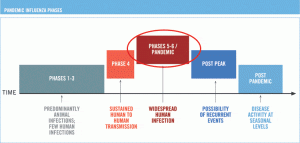
On Tuesday WHO raised the level of influenza pandemic alert from phase 4 to phase 5. According to WHO, “Phase 5 is characterized by human-to-human spread of the virus into at least two countries in one WHO region. While most countries will not be affected at this stage, the declaration of Phase 5 is a strong signal that a pandemic is imminent and that the time to finalize the organization, communication, and implementation of the planned mitigation measures is short.” WHO regions include African, European, Eastern Mediterranean, Americas, Southeast Asia, and Western Pacific. The cases in 4 European countries fulfilled the requirement for moving to phase 5.
Incredibly, Egypt began slaughtering 300,000 pigs as a ‘precautionary measure’ against the spread of swine flu. Farmers will not be compensated because the meat will be sold for consumption. This is a somewhat controversial move, because it is highly unlikely that pigs anywhere will play a role in further spread of the virus, which is now adapted to humans.
Sequences of viral RNAs from 20 swine flu isolates have now been posted on the NCBI website. Included are isolates from California, Texas, New York, Ohio, Kansas, and Germany (taken from a tourist who returned from Mexico). It is difficult to understand why RNA sequences of none of the Mexican isolates have been posted, which would enable us to determine if the viruses in that country are different from the others. However, examination of the sequences of the New York and German isolates, which presumably originated in Mexico, reveal no significant differences with sequences from other isolates. From this information I conclude that the apparent higher virulence of swine flu in Mexico is not a consequence of a genetically diverged virus.
Other interesting information that can be gleaned from sequence information is contained in a statement from CDC: “…the HA, PB2, PB1, PA, NP, NS genes
contain gene segments from influenza viruses isolated from swine in North America [such as, A/swine/Indiana/P12439/00], while the NA and M genes are most closely related to corresponding genes from influenza viruses isolated in swine population in Eurasia. However, the NA and M genes from 2 swine virus isolates from America are also closely related to the novel H1N1 virus (A/swine/Virginia/670/1987, A/swine/Virginia/67a/1987), if a reasonable nucleotide substitution rate is accepted. Thus, H1N1 from Mexico may be a swine flu virus strain of entirely American origin, possibly even of relatively ancient origin.” In the coming days I will attempt to construct a history of the evolution of swine influenza. In the meantime it may well be that this new human strain emerged from the US, as did the 1918-19 pandemic virus.
It is curious that CDC originally asserted that the new swine influenza virus inherited genes from human, pig, and bird viruses. Dr Anne Schuchat made this statement during a press conference on 23 Apr 2009, noting that “Preliminary testing of viruses from the 1st 2 patients shows that they are very similar. We know so far that the viruses contain genetic pieces from 4 different virus sources. This is unusual. The 1st is our North American swine influenza viruses. North American avian influenza viruses, human influenza viruses, and swine influenza viruses found in Asia and Europe. That particular genetic combination of swine influenza virus segments has not been recognized before in the US or elsewhere.”
I am not sure why the sequence information now available indicates a very different origin for these viruses.
Although many still describe this virus as swine flu, it is technically no longer a pig virus – having acquired the ability to be transmitted among humans and cause disease, it is now a human virus. I realize that the official strain names are cumbersome (A/Mexico/4482/2009 [H1N1]), and therefore it is likely that we will be using ‘swine flu H1N1’ at least until the next pandemic.
Regarding Dr. Schuchat's statement, could it be that if you trace the lineage of certain viral genome segments that their origin could be avian, for example? i.e., perhaps the A/swine/Indiana/P12439/00 isolate was/is a reassortant originally containing some segments of avian origin? Just a thought, I have not personally looked closely at these sequences…
But you still agree that this virus appears to contain genetic pieces from from four virus sources, correct? (one avian influenza viruses, one human influenza viruses, and two swine influenza viruses).
Does vaccination to seasonal flu confer any resistance to the mutated H1N1 version?
I don't understand why we don't have sequence data from the Mexico cases where individuals have died. Is it not possible that there are two strains out there and that the more virulent strain is still mostly contained in Mexico? The cases in San Diego were reported before we even knew about the Mexico outbreak. Are the Mexican deaths just calling attention to a different (existing) strain that isn't very virulent?
Why has there been no clarification of Anne Schuchat's comments? They were extraordinarily specific and it was clear at the time that she had a high confidence level that her remarks were accurate.
Specifically, can we have access to those same isolates that caused her to make that conclusion? Surely that bold assertion was based on an isolate she possessed.
Where is that isolate now?
Don't we have a right to know?
How do we account for the April 24 comments of Dr. Marie Gramer below, who has perhaps the largest library of swine flu virus isolates in the nation the day after Schuchat's comments?
http://cottontopssandbox.wordpress.com/2009/04/…
Excerpted here for your convenience:
“There have been no reports of this virus in pigs, said Dr. Marie Gramer, a swine flu expert with the University of Minnesota’s college of veterinary medicine. “It doesn’t seem to be very similar to anything that is currently circulating, from what I have,†said Gramer, who has an extensive library of swine flu virus isolates. Continued:
http://www.medicinehatnews.com/content/view/938… “
Where are the isolates that she examined that caused her to make these comments physically located right now?
Why have the only fatalities been Mexican? “Are the Mexican deaths just calling attention to a different (existing) strain that isn't very virulent?”
Wouldn't it be the opposite? If only Mexicans have died, would this not be evidence that their strains are MORE virulent?
Also, the biggest cluster of infection outside of Mexico is New York City. Why is this?
I do not understand why you are morally certain that the German and New York isolates arose from Mexico.
What factual basis is there to form a positive, irrevocable conclusion that there were not two separate outbreaks?
I think it is exceedingly premature to conclude that; we only have anecdotes to support it.
Also, the critical phrase “reasonable nucleotide substitution rate” remains undefined and I'm not certain all (or even a majority) of virologists would agree on what that term means. Precisely what quantitative assumptions describe that phrase?
Hugo vet from Mexico (actually animal geneticist), very interesting information. Thanks for the posts.
Yes. What I was trying to say is that the sequenced strain outside Mexico is less virulent and may have been around without anyone really noticing (at least for a few weeks). Once Mexicans starting dying from their different strain, we incorrectly concluded that the less virulent strain was the same strain as the deadly Mexican strain. This is just a hypothesis – but one that can't be falsified until we get sequences from Mexican patients.
Mexico's chief epidemiologist insists this virus did not begin in a Mexican pig farm.
Excerpted from:
http://www.reuters.com/article/lifestyleMolt/id…
“Miguel Angel Lezana, Mexico's chief epidemiologist, told reporters…. the presence of Eurasian swine flu genes in the H1N1 virus makes it unlikely that the disease originated in a Mexican pig farm.”
It's taken me a while to digest the fact that the Mexican flu viruses haven't been sequences. Shouldn't this be bigger news? Why is it confined to a relatively obscure blog? (No offense, Dr. Racaniello.)
For some reason the news media are still claiming this swine flu is made up of 4 different segments from human, avian and swine. On the Today show this morning they had blocks that they were using to demonstrate where the different parts of the virus came from and proceeded to “build” a virus made up of the different animal strains. I think this really needs to be cleared up with the public.
This might sound a bit stupid on my part, but why are they described as RNA sequences? When I looked on the site the sequences had thymine in them, and I thought that was replaced by uracil in RNA.
The viral RNA is converted to DNA and that is what is sequenced, so
you see thymines. But it's the sequence of the viral RNA, since of
course the viral genome is not DNA.
I think that Today doesn't read obscure blogs such as this one,
otherwise they would know better. Perhaps I will create a graphic
illustration of the viral genome showing the origin of RNA segments.
Canine influenza emerged a few years ago in Florida in greyhounds, and was found to have come from an equine influenza strain. However, after entering the canine population, the virus is no longer able to infect horses. Perhaps a similar thing is occurring here.
Also, it seems that this H1N1 swine influenza may have actually come from China, based on some information I have from a virology professor at the veterinary school I attend. He has been receiving information from people he knows at the CDC.
I did come up with one possible explanation for the protracted delay in obtaining sequencing for Mexican isolates.
I recall that in 2007, there was a big dustup between Indonesia and the WHO over sharing of bird flu isolates because the Indonesians apparently demanded greater quantities of any vaccine developed as a result of Indonesian samples.
Most of the vaccine manufacturing capacity lies in the Northern industrialized world and if this virus comes back with a vengeance this winter there is likely to be extreme competition for the first production units. And third world countries such as Mexico and Indonesia are understandably concerned that any distribution system should not be based strictly on wealth.
Given this recent Indonesian dustup that received far more coverage in the Global South than in the US, Mexico may be playing hardball behind the scenes along the lines of what Indonesia did.
Here is a short recitation of the Indonesian controversy:
http://www.thefreelibrary.com/Indonesia+stands+…
Whatever the reason, this strikes me as THE BIG STORY that is not being reported.
At the end of a recent Science Magazine interview, Dr. Donis of the CDC states that the USA has received 300 samples of this virus from Mexico. That interview is cited favorably by this blog.
It seems to be a conscious and intentional decison not to publish those sequences. And it seems that the Americans are partipating in the decision not to publish.
Why would the CDC fail to publish the sequences of any of the 300 samples Dr. Donis says they have received from Mexico?
Matt Dubuque
We are facing the virus of the second wave of H1N1 of 1918. The HA and NS1 gene actually comes from the virus of 1918 which has transmitted to pigs in 1918 and has now resurfaced. If we look at the mortality rate in Mexico, those between 20-60 are very similar to the mortality rate of 1918. The mortality rate in children is much lower probably due to vaccination against Haemophilus Influenza and pneumococcus. Most of the children died not due to the influenza but due to bacterial co-infection which would increase the mortality rate by 10 folds. More women are affacted because the mothers have to take care of the sick children. The low mortality rate in United States is due to vaccination program against pneumococcus and Haemophilus Influenza in the past, better healthcare level, better sanitation and nutritional status. Moreover the death are delayed due to intensive care. If you look at the figures of W.H.O., the mortality rate of U.S.A. is slowly rising to > 0.2 %. The mortality would suddenly jump if the demand for healthcare has outstrip the capacity of the exiting facilities if the mitigation process is inefficient.
We are facing the virus of the second wave of H1N1 of 1918. The HA and NS1 gene actually comes from the virus of 1918 which has transmitted to pigs in 1918 and has now resurfaced. If we look at the mortality rate in Mexico, those between 20-60 are very similar to the mortality rate of 1918. The mortality rate in children is much lower probably due to vaccination against Haemophilus Influenza and pneumococcus. Most of the children died not due to the influenza but due to bacterial co-infection which would increase the mortality rate by 10 folds. More women are affacted because the mothers have to take care of the sick children. The low mortality rate in United States is due to vaccination program against pneumococcus and Haemophilus Influenza in the past, better healthcare level, better sanitation and nutritional status. Moreover the death are delayed due to intensive care. If you look at the figures of W.H.O., the mortality rate of U.S.A. is slowly rising to > 0.2 %. The mortality would suddenly jump if the demand for healthcare has outstrip the capacity of the exiting facilities if the mitigation process is inefficient.
Pingback: Swine Flu Pandemic: FACT vs FICTION | LushCanopy
Pingback: Alan Dove » Blog Archive » The Other White Meat