
 The treatment of AIDS patients with a combination of three or four antiviral drugs is known as HAART, or highly active antiretroviral therapy. Combination therapy has been effective for long-term control of infection, and represents one of the high points in AIDS research. The downside of HAART is that strict adherence to daily therapy must be maintained, and toxicity and viral resistance are continuing problems. Is there an alternative for AIDS patients?
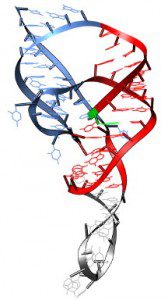
The results of a phase 2 gene therapy trial suggest that gene therapy with an anti-HIV ribozyme could control HIV-1 replication in AIDS patients. A ribozyme is an enzyme made of RNA, not protein. Examples include the group I intron of Tetrahymena thermophila (the first ribozyme discovered), RNAse P of bacteria, group II self-splicing introns, and the hepatitis delta ribozyme. They differ widely in size, sequence, and mechanism of catalysis. They can cleave their own phosphodiester bonds, or those of other RNAs – which is why they are being explored as antiviral and antitumor agents.
The ribozyme used in the phase 2 study, which targets two overlapping open reading frames of HIV-1, was previously shown to inhibit viral replication in cultured cells. The ribozyme was incorporated into a retrovirus vector, which was then used to infect peripheral blood CD34+ stem cells that had been obtained from each patient. The stem cells were placed in culture, infected with the ribozyme-containing retrovirus, and then the cells were injected intravenously back into each patient. A total of 38 patients received cells that had been infected with the ribozyme-containing retrovirus, while 36 patients received cells that had been infected with a control retrovirus. Six months later, HAART therapy was halted for 4 weeks, to allow increased reproduction of HIV-1. The idea was that the virus would kill lymphocytes that lack the ribozyme, and that ribozyme-expressing immune cells would expand in number.
The treatment regimen was well-tolerated by all patients, and no adverse side effects were observed. The levels of HIV-1 in the blood of patients who received the ribozmye-expressing cells were consistently lower than patients in the control group. Lymphocytes of the CD4+ class – the kind infected by HIV-1 – were also more numerous in the blood of ribozyme-treated patients. These observations demonstrate that a single-dose gene therapy approach has great potential for treating AIDS.
Curiously, no viral mutants emerged in the patients that were resistant to the ribozyme. Nor had such mutations been previously observed in cell culture studies. Why such resistance mutations have not been described is a mystery – a single base change in the region of HIV-1 targeted by the ribozyme should be sufficient to prevent cleavage and inactivation of the viral genome. Because this region of the HIV-1 genome is highly conserved, mutations might produce less fit viruses which cannot compete with ribozyme-sensitive viruses.
Ronald T Mitsuyasu, Thomas C Merigan, Andrew Carr, Jerome A Zack, Mark A Winters, Cassy Workman, Mark Bloch, Jacob Lalezari, Stephen Becker, Lorna Thornton, Bisher Akil, Homayoon Khanlou, Robert Finlayson, Robert McFarlane, Don E Smith, Roger Garsia, David Ma, Matthew Law, John M Murray, Christof von Kalle, Julie A Ely, Sharon M Patino, Alison E Knop, Philip Wong, Alison V Todd, Margaret Haughton, Caroline Fuery, Janet L Macpherson, Geoff P Symonds, Louise A Evans, Susan M Pond, David A Cooper (2009). Phase 2 gene therapy trial of an anti-HIV ribozyme in autologous CD34+ cells Nature Medicine DOI: 10.1038/nm.1932
For sure there is a cure for HIV,that is if you are strong in mindand beleive in god and take some herbal madicine like the indian bio magnetic card with the madicines which dores not have side effect you can be cured but expensive.
Pingback: GlmS glucosamine-6-phosphate activated ribozyme @ Nordbanen
Gene therapy with Anti-HIV ribozyme seems to be quite effective then HAART for treating AIDS.This will be beneficial for AIDS patients.
Great posting. I like this.
Thanks for sharing your tips.
HIV, or the human immunodeficiency virus, is a sexually transmitted disease that assails the immune system. The virus attacks your CD4 cells (or T4 cells), which are necessary to fight off illnesses. Eventually, the virus overwhelms the CD4 cells and your body becomes unable to fight off diseases and infections.HIV symptoms
Sexual transmission of HIV has been described from men to men, men to women, women to men, and women to women through vaginal, anal, and oral sex. The best way to avoid sexual transmission is abstinence from sex until it is certain that both partners in a monogamous relationship are not HIV-infected. Because the HIV antibody test can take up to six months to turn positive after infection occurs, both partners would need to test negative six months after their last potential exposure to HIV. If abstinence is out of the question, the next best method is the use of latex barriers. This involves placing a condom on the penis as soon as an erection is achieved in order to avoid exposure to pre-ejaculatory and ejaculatory fluids that contain infectious HIV. For oral sex, condoms should be used for fellatio (oral contact with the penis) and latex barriers (dental dams) for cunnilingus (oral contact with the vaginal area). A dental dam is any piece of latex that prevents vaginal secretions from coming in direct contact with the mouth. Although such dams occasionally can be purchased, they are most often created by cutting a square piece of latex from a condom.
Sexual transmission of HIV has been described from men to men, men to women, women to men, and women to women through vaginal, anal, and oral sex. The best way to avoid sexual transmission is abstinence from sex until it is certain that both partners in a monogamous relationship are not HIV-infected. Because the HIV antibody test can take up to six months to turn positive after infection occurs, both partners would need to test negative six months after their last potential exposure to HIV. If abstinence is out of the question, the next best method is the use of latex barriers. This involves placing a condom on the penis as soon as an erection is achieved in order to avoid exposure to pre-ejaculatory and ejaculatory fluids that contain infectious HIV. For oral sex, condoms should be used for fellatio (oral contact with the penis) and latex barriers (dental dams) for cunnilingus (oral contact with the vaginal area). A dental dam is any piece of latex that prevents vaginal secretions from coming in direct contact with the mouth. Although such dams occasionally can be purchased, they are most often created by cutting a square piece of latex from a condom.
HELLO, i want to share this wonderful testimony to the world as a
whole in case there is some body in this same situation. i was
diagnosed of HIV in the year 2009 until i meant testimony online by a
woman with name Anita about a man called Dr Okoro , i was not too sure
if it was real until i contacted him my self . I thought that there
was never a cure for my deadly ailment but Dr Okoro told me that his
herbs could cure me, and then i decided to give him a try, he then
told me that once i start taking his herbs, that it will only take me
some days to be cured, i believed him and took the herb with faith.
after he gave me the medication, i took it and i was feeling some new
signs in my body and i decided to go for a test and the result stated
that i was HIV negative, i was very happy and even called my pastor
and told him about it, i am very happy that i am now HIV negative and
i am also happy that i will not be celebrating this Christmas as an
HIV patient as i have did for the past 4 years, so help me say a very
big thank you to Doctor Okoro for saving me from the hands of the
deadly ailment. if you are also in this type of situation and you are
seeking for solution, seek no more for you have received the right
information you have been wanting for a very long time in this type of
issues you are very free to contact Dr Okoro today through his private
email: Drokorotemplt@gmail.com or call him on his mobile number :
+2348051785597. i strongly believe that he will help you out just as
he did mine, stay cool and God bless Merry Xmas and a Happy New Year
in advance.
email: DROKOROTEMPLE@GMAIL.COM